
Cardiac Physiology
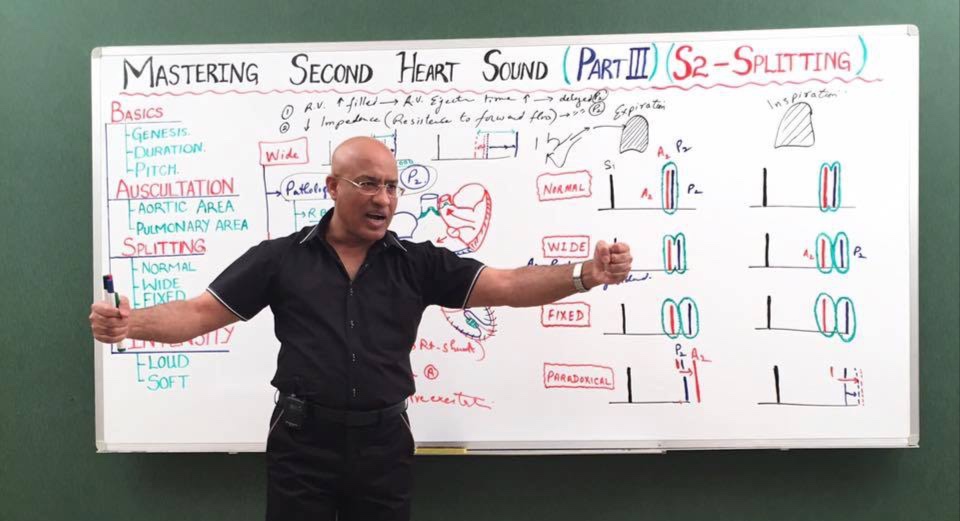
Few subjects reward understanding as generously as the heart. Once you see why the ventricle fills, squeezes and relaxes in a fixed order, the ECG, the heart sounds and the murmurs stop being separate topics and become one story. In 51 hand-drawn lectures, Dr. Najeeb builds that story from the first ion channel to the last heart sound, so you can reason through a tracing or a stethoscope finding instead of memorizing it. The course is taught by a teacher with over 40 years of experience.
| At a glance | Cardiac Physiology |
|---|---|
| Taught by | Dr. Najeeb, over 40 years of teaching experience |
| Lectures | 51 video lecture parts in 6 modules |
| Format | Live whiteboard drawing, one idea at a time |
| Starting point | No background needed; the course begins with cardiac electrophysiology |
| Membership | Lifetime access with the premium plan, future lectures included |
| Study notes | Handwritten notes for every lecture, sold separately (Notes add-on or Combo Plan) |
| Try before you buy | Sample lectures through a free “Try Us Free” account |
| Best for | Medical, dental, nursing and physiotherapy students; USMLE Step 1, PLAB, COMLEX and NEET PG candidates |
Why Cardiac Physiology feels easier here
Cardiac physiology is often taught as three disconnected blocks: electricity, mechanics and sounds. Here they are taught as one system, with every diagram linked to the one before it.
- The ECG is built lead by lead, so you learn why a deflection points up or down rather than memorizing patterns.
- The cardiac cycle, pressure-volume loops and cardiac output are drawn together, which makes preload, afterload and contractility easy to separate.
- Heart sounds and murmurs are explained by valve events, so you can predict what you will hear before you listen.
- Handwritten notes for every lecture give you a clean page for revision.
What you will be able to do after this course
- Explain how the cardiac action potential and the conduction system generate each heartbeat
- Read an ECG systematically, from the leads to the QRS complex to rhythm and axis
- Describe every phase of the cardiac cycle and link it to pressure, volume and valve movement
- Distinguish preload, afterload and contractility and predict how cardiac output responds
- Interpret the jugular venous pulse and its waveforms
- Identify the first, second, third and fourth heart sounds and explain splitting
- Explain systolic and diastolic murmurs, clicks and the signs of mitral stenosis
- Recognize apex beat patterns and the clinical meaning of pre-excitation in Wolff-Parkinson-White syndrome
Where cardiac physiology meets the clinic
- Arrhythmias and their electrophysiological basis
- Wolff-Parkinson-White syndrome and pre-excitation
- Mitral stenosis and its heart sounds
- Valve disease and the murmurs it produces
- Heart failure and the pressure-volume loop
- Raised jugular venous pressure and what it signals
Lecture roadmap: 51 parts in 6 modules
| Module | Topics (number of lecture parts) | Parts |
|---|---|---|
| 1. Electrophysiology and arrhythmias | Electro-Physiology of the Heart (2); Cardiac Arrhythmias, Basic Concepts (3); Wolff-Parkinson-White Syndrome (2) | 7 |
| 2. ECG foundations | Bipolar Limb Leads (2); Augmented Unipolar Limb Leads (1); Chest Leads (1); QRS Nomenclature (1); QRS in Chest Leads (1); Abnormalities of R Wave Progression (1) | 7 |
| 3. EKG interpretation | EKG Interpretation (4) | 4 |
| 4. Cardiac cycle and pump function | Cardiac Cycle (2); Myocardial Contractility (4); Cardiac Output (4); Left Ventricular Pressure-Volume Loops (1); Jugular Venous Pulse and Pressures (2) | 13 |
| 5. Heart sounds and murmurs | First Heart Sound with Clinical Correlates (3); Second Heart Sound (4); Third and Fourth Heart Sounds (1); Heart Sounds and Murmurs (5); Systolic Clicks (2); Diastolic Sounds and Murmurs (2) | 17 |
| 6. Bedside signs | Heart Sounds in Mitral Stenosis (1); Normal vs Heaving Apex Beat (1); Heaving vs Thrusting Apex Beat (1) | 3 |
Total: 51 lecture parts.
Is this course for you?
- Medical students meeting cardiac physiology for the first time
- Dental, nursing and physiotherapy students who need a firm grasp of the heart
- Anyone preparing for a cardiovascular block exam or OSCE
- Candidates preparing for USMLE Step 1, PLAB, COMLEX or NEET PG
If the ECG has always looked like a puzzle, the lectures on leads and the QRS complex are the best place to begin.
How to get the most from it
- Learn the cardiac action potential first, then move to the ECG, since each trace is a record of that electrical event.
- Redraw the cardiac cycle and pressure-volume loop from memory after each lecture.
- Listen to heart sounds while reading the matching lecture, so the sound and the mechanism stay together.
- Use the handwritten notes for same-day revision.
Study Cardiac Physiology alongside ECG Series (EKG) for a focused set of ECG lectures, Cardiac Pathology for the diseases behind abnormal sounds and tracings, Vascular Physiology for blood pressure and hemodynamics, Membrane Physiology for the action potential in detail and Clinical Medicine for bedside cardiology cases.
Cardiac Physiology: quick answers
What happens during the cardiac cycle?
The cycle has four phases: ventricular filling, isovolumetric contraction, ejection and isovolumetric relaxation. The atrioventricular valves close at the start of systole, producing the first heart sound, and the aortic and pulmonary valves close at the end of systole, producing the second.
How is cardiac output calculated?
Cardiac output equals heart rate multiplied by stroke volume. At rest it is about 5 liters per minute in a healthy adult, and stroke volume depends on preload, afterload and myocardial contractility.
What is the Frank-Starling law?
Within physiological limits, a greater end-diastolic volume stretches the myocardial fibers and produces a stronger contraction. This lets the heart match its output to the volume of blood returning to it.
What causes the first and second heart sounds?
The first sound (S1) comes from closure of the mitral and tricuspid valves, and the second sound (S2) from closure of the aortic and pulmonary valves. S2 normally splits during inspiration.
What do the PR interval and QRS complex represent?
The PR interval reflects conduction delay through the atrioventricular node and normally lasts 0.12 to 0.20 seconds. The QRS complex represents ventricular depolarization and normally lasts less than 0.12 seconds.
What does Wolff-Parkinson-White syndrome show on an ECG?
An accessory pathway bypasses the atrioventricular node, causing pre-excitation. The ECG shows a short PR interval, a delta wave and a wide QRS complex, and patients are prone to re-entrant tachycardias.
What does the jugular venous pulse tell you?
The jugular venous pulse reflects right atrial pressure. Its a, c and v waves and x and y descents correspond to atrial contraction, ventricular systole and venous filling, and changes in them point to specific cardiac conditions.
Frequently asked questions
Do I need prior knowledge before starting cardiac physiology?
No. The course starts with the electrical basis of the heartbeat and builds upward, so a complete beginner can follow it. If you already know the basics, it works well as a rapid revision of the ECG, cardiac cycle and heart sounds.
How many lectures are in the cardiac physiology course?
The course contains 51 lecture parts organized into 6 modules.
Which topics does the cardiac physiology course cover?
It covers cardiac electrophysiology, arrhythmias, Wolff-Parkinson-White syndrome, ECG leads and interpretation, the cardiac cycle, myocardial contractility, cardiac output, pressure-volume loops, the jugular venous pulse, heart sounds, murmurs and apex beat patterns.
Can I try some lectures before I buy?
Yes. Create a free Try Us Free account to watch sample lectures and see how Dr. Najeeb teaches before you choose a plan.
Do the lectures come with notes?
Yes. Handwritten notes are available for every lecture in this course. They are sold separately through the Notes add-on or the Combo Plan.
How long do I keep access to the lectures?
The premium plan gives you lifetime access, including any new lectures added to the library later.
Can I watch the lectures offline?
Offline viewing works only inside the official Dr. Najeeb Lectures app. The videos cannot be downloaded as separate files.
Will this course help with USMLE, PLAB, COMLEX or NEET PG?
It covers the cardiac physiology content that these exams test. It does not include a question bank or a certificate.
Can I get a refund?
Dr. Najeeb Lectures offers a 7-day refund. Email support@drnajeeblectures.com to request one.