
Cardiac Pathology
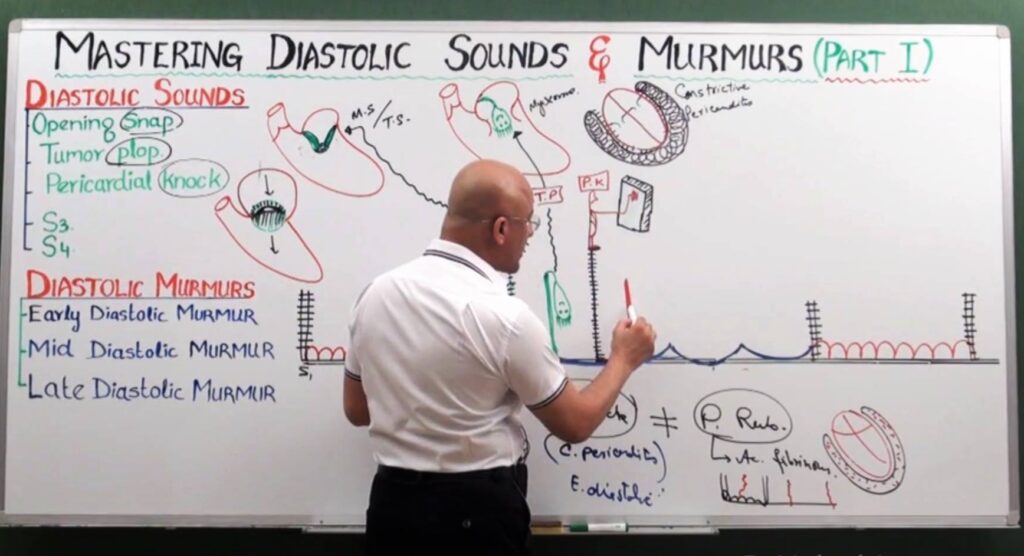
A heart under strain tells its story in three ways: what the tissue looks like, what the valves sound like and what the patient feels. Dr. Najeeb’s Cardiac Pathology course brings all three together. Across 43 hand-drawn lectures, you move from ischemic heart disease and heart failure through every major valve lesion, the diseases of the myocardium and pericardium, and congenital heart disease, with the bedside signs placed beside the pathology that causes them. The course is taught by a teacher with over 40 years of experience.
| At a glance | Cardiac Pathology |
|---|---|
| Teacher | Dr. Najeeb, over 40 years of teaching experience |
| Number of lectures | 43 video lecture parts in 4 modules |
| How it is taught | Live whiteboard drawing, one idea at a time |
| Where to begin | No background needed; the lectures build from the basic changes in the diseased heart |
| Plan | Lifetime access with the premium plan, future lectures included |
| Handwritten notes | Handwritten notes for every lecture, sold separately (Notes add-on or Combo Plan) |
| Sample lectures | Sample lectures through a free “Try Us Free” account |
| Suited to | Medical, dental, nursing and physiotherapy students; USMLE Step 1, PLAB, COMLEX and NEET PG candidates |
Learn cardiac pathology by understanding, not memorizing
Cardiac pathology is easier when the disease, the murmur and the symptom are taught as one picture. That is how these lectures are built.
- Ischemic heart disease is covered in nine lectures, so the full spectrum from angina to infarction is clear.
- Each valve lesion is drawn with its cause, its murmur and its consequence.
- Bedside topics such as apex beat patterns sit next to the pathology behind them.
- Congenital heart disease is organized in a way that makes shunts and cyanosis easy to reason out.
- Handwritten notes for every lecture give you a clear revision set.
By the end you will understand
- Explain the pathogenesis and consequences of ischemic heart disease
- Describe the causes and mechanisms of heart failure
- Explain the pathology of mitral, aortic, tricuspid and pulmonary valve disease
- Describe rheumatic fever and rheumatic heart disease
- Distinguish the cardiomyopathies
- Explain myocarditis, pericarditis and endocarditis
- Classify congenital heart diseases and predict their physiology
- Connect murmurs and apex beat findings to the underlying lesion
Real-world and exam relevance
- Myocardial infarction and its complications
- Heart failure
- Mitral stenosis and regurgitation
- Aortic stenosis and regurgitation
- Infective endocarditis
- Cardiomyopathies
- Congenital heart disease
Course map: 43 lecture parts, module by module
| Module | Topics (number of lecture parts) | Parts |
|---|---|---|
| 1. Ischemic heart disease and heart failure | Ischemic Heart Disease (9); Cardiac Failure (5) | 14 |
| 2. Valvular heart disease | Rheumatic Fever and Rheumatic Heart Disease (1); Mitral Prolapse and Regurgitation (2); Mitral Stenosis (4); Aortic Stenosis and Regurgitation (3); Tricuspid and Pulmonary Valve Disease (1); Heart Sounds in Mitral Stenosis (1); Apex Beat Patterns (2) | 14 |
| 3. Myocardium, pericardium and endocardium | Cardiomyopathies (3); Myocarditis (1); Pericarditis (2); Endocarditis (2); Cardiac Tumors (1) | 9 |
| 4. Congenital heart disease | Congenital Heart Diseases (6) | 6 |
Total: 43 lecture parts.
Built for these learners
- Medical students meeting cardiac pathology for the first time
- Nursing and physiotherapy students who care for cardiac patients
- Anyone revising valve disease and myocardial infarction before an exam
- Candidates preparing for USMLE Step 1, PLAB, COMLEX or NEET PG
If you can already describe a normal heart, this course shows you what each disease changes.
Study tips built into the course design
- Work through ischemic heart disease first, since it is the most examined topic.
- Learn each valve lesion with its murmur and its consequence together.
- Draw the shunts of congenital heart disease before memorizing the names.
- Use the handwritten notes for same-day revision.
To see the bigger picture, continue with Cardiac Physiology for the mechanics, sounds and ECG behind these diseases, ECG Series (EKG) for reading the tracings of cardiac disease, Vascular Pathology for atherosclerosis and aortic disease, Clinical Medicine for pericarditis, tamponade and rheumatic fever cases and Pharmacology for drugs for heart failure and angina.
Cardiac Pathology in brief
What causes ischemic heart disease?
Most cases are caused by atherosclerotic narrowing of the coronary arteries. The spectrum includes stable and unstable angina, myocardial infarction and sudden cardiac death.
How does a myocardial infarction change over time?
Coagulative necrosis develops in the first day, neutrophils arrive over days one to three, macrophages clear debris over days three to seven, granulation tissue forms in the following weeks and a fibrous scar is established by about two months.
What are the main types of cardiomyopathy?
The main types are dilated, hypertrophic and restrictive cardiomyopathy, which differ in the way the myocardium is structurally and functionally affected.
What causes rheumatic fever?
Rheumatic fever follows group A streptococcal pharyngitis through molecular mimicry between bacterial and cardiac antigens. The mitral valve is the one most often damaged.
What are the features of mitral stenosis?
Mitral stenosis is usually rheumatic. It causes left atrial enlargement, atrial fibrillation risk, a loud first sound, an opening snap and a diastolic rumbling murmur.
What is the classic presentation of aortic stenosis?
Calcific aortic stenosis causes angina, syncope and heart failure, with a harsh systolic ejection murmur.
Which organisms cause infective endocarditis?
Staphylococcus aureus causes acute endocarditis, often on normal valves, and viridans streptococci cause subacute disease on previously damaged valves.
What is the most common congenital heart defect?
Ventricular septal defect is the most common congenital heart defect. Congenital lesions are grouped as cyanotic or acyanotic depending on whether blood is shunted away from the lungs.
Your questions, answered
Do I need prior knowledge before starting cardiac pathology?
No. The lectures begin with the basic changes in the diseased heart and build step by step, so a beginner can follow them. If you already know the basics, they work well as a rapid revision of valve disease and ischemic heart disease.
How many cardiac pathology lectures can I watch?
The course contains 43 lecture parts organized into 4 modules.
Which topics does the cardiac pathology course cover?
It covers ischemic heart disease, heart failure, rheumatic fever, mitral, aortic, tricuspid and pulmonary valve disease, cardiomyopathies, myocarditis, pericarditis, endocarditis, cardiac tumors, congenital heart disease and bedside signs.
Can I try some lectures before I buy?
Yes. Sign up for a free Try Us Free account, watch the sample lectures, then decide whether to upgrade.
Do the lectures come with notes?
Yes. Handwritten notes are available for every lecture in this course. They are sold separately through the Notes add-on or the Combo Plan.
How long do I keep access to the lectures?
With the premium plan you keep access permanently, and new lectures are included at no extra cost.
Can I watch the lectures offline?
Offline access is limited to the official Dr. Najeeb Lectures app, and the videos cannot be saved as standalone files.
Will this course help with USMLE, PLAB, COMLEX or NEET PG?
It covers the cardiac pathology content that these exams test. It does not include a question bank or a certificate.
Can I get a refund?
Refunds are available within 7 days. Email support@drnajeeblectures.com and the team will help.