
Renal Physiology
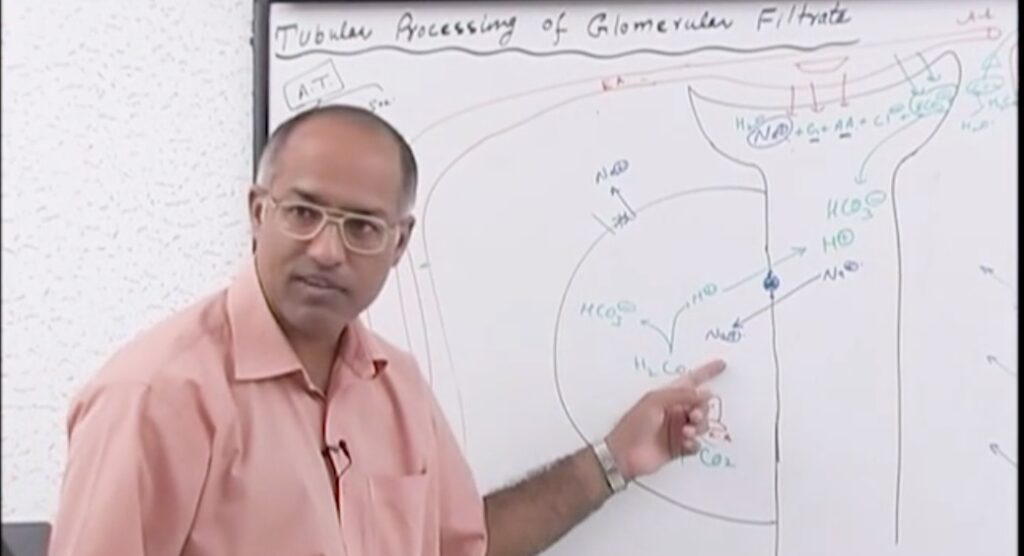
The kidney filters about 180 liters of plasma a day and returns almost all of it, yet the few liters that remain tell a doctor an enormous amount. Renal physiology has a reputation for difficulty because each nephron segment does something different. Dr. Najeeb solves that by drawing the nephron one segment at a time, then joining the segments into a working whole. In 17 hand-drawn lectures, you learn what is filtered, what is returned and what the body decides to keep. The course is taught by a teacher with over 40 years of experience.
| At a glance | Renal Physiology |
|---|---|
| Taught by | Dr. Najeeb, over 40 years of teaching experience |
| Lectures | 17 video lecture parts in 4 modules |
| Format | Live whiteboard drawing, one idea at a time |
| Starting point | No background needed; the lectures begin with an introduction to the kidney |
| Membership | Lifetime access with the premium plan, future lectures included |
| Study notes | Handwritten notes for every lecture, sold separately (Notes add-on or Combo Plan) |
| Try before you buy | Sample lectures through a free “Try Us Free” account |
| Best for | Medical, dental, nursing and pharmacy students; USMLE Step 1, PLAB, COMLEX and NEET PG candidates |
The Dr. Najeeb approach to renal physiology
Renal physiology only seems hard when the nephron is taught as a list. These lectures teach it as a journey, with a clear reason for every step.
- Each tubular segment is drawn with its transporters and its job, so you can predict the effect of a diuretic or a hormone.
- Filtration is explained through the forces that drive it, so changes in GFR can be reasoned out.
- Urine concentration is shown as a countercurrent system, which makes dilute and concentrated urine easy to follow.
- Handwritten notes for every lecture give you a clean revision set.
Key topics you will master
- Describe the structure of the glomerulus and the filtration barrier
- Explain how glomerular filtration rate is determined and regulated
- Follow the reabsorption and secretion of key solutes along the nephron
- Explain how the kidney concentrates and dilutes urine
- Describe the renin-angiotensin-aldosterone system and its effects on blood pressure and sodium
- Predict how common diuretics and hormones change urine output
Clinical pearls inside the lectures
- Reduced GFR and kidney injury
- Effects of diuretics on tubular transport
- Diabetes insipidus and water balance
- Hypertension and the RAAS
- Sodium and potassium handling
- Changes in urine concentration in disease
The complete lecture list (17 parts)
| Module | Topics (number of lecture parts) | Parts |
|---|---|---|
| 1. Foundations | Introduction to Renal Physiology (2); Glomerular Structure (1) | 3 |
| 2. Glomerular filtration | Glomerular Filtration Rate (4) | 4 |
| 3. Tubular processing | Renal Tubular Processing (7) | 7 |
| 4. Concentration and hormonal control | Urine Concentration and Dilution (2); Renin-Angiotensin-Aldosterone System (1) | 3 |
Total: 17 lecture parts.
Perfect if you are
- Medical students meeting renal physiology for the first time
- Pharmacy and nursing students who need to understand diuretics
- Anyone revising the nephron before an exam
- Candidates preparing for USMLE Step 1, PLAB, COMLEX or NEET PG
If the nephron has always felt like a maze, the tubular processing lectures give you a map.
A suggested study routine
- Learn glomerular filtration thoroughly before moving to the tubules.
- Draw the nephron from memory after each tubular lecture, labeling the transporters.
- Revisit the RAAS lecture after urine concentration, since the two meet in sodium and water balance.
- Use the handwritten notes for same-day revision.
Related courses in the Video Library: Renal Pathology for glomerular disease and its syndromes, Vascular Physiology for blood pressure and body fluids, Membrane Physiology for transport across membranes, Pharmacology for diuretics and antihypertensive drugs and Endocrine Physiology for aldosterone, ADH and hormonal control.
Quick facts on renal physiology
What is the normal glomerular filtration rate?
In a healthy young adult the GFR is about 125 mL per minute, or roughly 180 liters per day. It is set by the Starling forces across the glomerular capillary and by the filtration coefficient.
What forms the glomerular filtration barrier?
The barrier has three layers: fenestrated endothelium, the glomerular basement membrane and the filtration slits between podocyte foot processes. The basement membrane carries a negative charge that restricts filtration of albumin.
What does the proximal tubule do?
The proximal tubule reabsorbs about two thirds of the filtered sodium and water, and under normal conditions nearly all of the filtered glucose and amino acids.
How does the loop of Henle help concentrate urine?
The loop acts as a countercurrent multiplier. The thick ascending limb pumps out solute without water, building a hypertonic medullary interstitium that draws water out of the collecting duct when ADH is present.
What does ADH do in the kidney?
Antidiuretic hormone inserts aquaporin-2 channels into the collecting duct, so water is reabsorbed and a small volume of concentrated urine is produced.
What does the renin-angiotensin-aldosterone system do?
Falling renal perfusion triggers renin release. Angiotensin II then constricts blood vessels and stimulates aldosterone, which increases sodium reabsorption and potassium excretion, raising blood volume and pressure.
How is GFR kept stable?
Two mechanisms, myogenic response and tubuloglomerular feedback, adjust afferent arteriolar tone so that GFR stays steady across a wide range of blood pressures.
Answers before you enrol
Do I need prior knowledge before starting renal physiology?
No. The course begins with an introduction to the kidney and builds step by step, so a beginner can follow it. If you already know the basics, it works well as a fast revision of tubular transport and urine concentration.
How many lectures are in the renal physiology course?
The course contains 17 lecture parts organized into 4 modules.
Which topics does the renal physiology course cover?
It covers the introduction to renal physiology, glomerular structure, glomerular filtration rate, renal tubular processing, urine concentration and dilution and the renin-angiotensin-aldosterone system.
Can I try some lectures before I buy?
Yes. Create a free Try Us Free account to watch sample lectures and see how Dr. Najeeb teaches before you choose a plan.
Do the lectures come with notes?
Yes. Handwritten notes are available for every lecture in this course. They are sold separately through the Notes add-on or the Combo Plan.
How long do I keep access to the lectures?
The premium plan gives you lifetime access, including any new lectures added to the library later.
Can I watch the lectures offline?
Offline viewing works only inside the official Dr. Najeeb Lectures app. The videos cannot be downloaded as separate files.
Will this course help with USMLE, PLAB, COMLEX or NEET PG?
It covers the renal physiology content that these exams test. It does not include a question bank or a certificate.
Can I get a refund?
Dr. Najeeb Lectures offers a 7-day refund. Email support@drnajeeblectures.com to request one.