
Renal Pathology
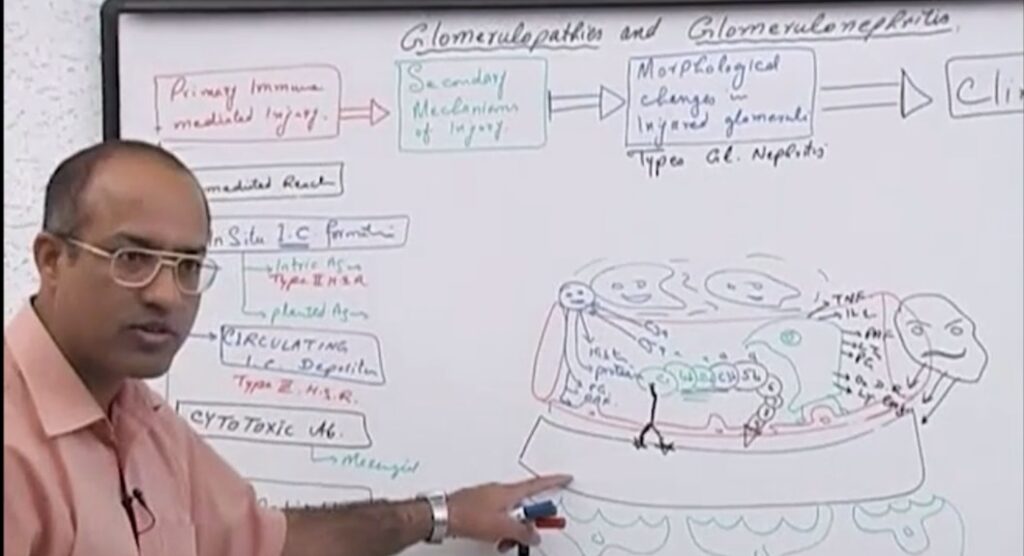
Most glomerular disease looks confusing until you know which part of the filter has failed. A leaking barrier produces protein in the urine; an inflamed one produces blood. This focused course takes that single idea and uses it to organize glomerular disease. In six hand-drawn lectures, Dr. Najeeb explains the structure of the glomerulus, the basic concepts of glomerulonephritis and the two great syndromes, nephrotic and nephritic. The course is taught by a teacher with over 40 years of experience.
| At a glance | Renal Pathology |
|---|---|
| Taught by | Dr. Najeeb, over 40 years of teaching experience |
| Lectures | 6 video lecture parts in 2 modules |
| Format | Live whiteboard drawing, one idea at a time |
| Starting point | No background needed; the lectures begin with glomerular structure |
| Membership | Lifetime access with the premium plan, future lectures included |
| Study notes | Handwritten notes for every lecture, sold separately (Notes add-on or Combo Plan) |
| Try before you buy | Sample lectures through a free “Try Us Free” account |
| Best for | Medical, dental, nursing and pharmacy students; USMLE Step 1, PLAB, COMLEX and NEET PG candidates |
The Dr. Najeeb approach to renal pathology
A small course can solve a large problem. Nephrotic and nephritic syndromes are among the most examined topics in renal pathology, and these lectures make the difference clear.
- The structure of the filter comes first, so every disease is linked to a part of it.
- Nephrotic and nephritic syndromes are compared on the same axes, which makes them easy to separate.
- Glomerulonephritis is introduced through basic concepts before the details.
- Handwritten notes for every lecture give you a clear revision set.
Key topics you will master
- Describe the structure of the glomerular filtration barrier
- Explain the basic concepts of glomerulonephritis
- Distinguish nephrotic from nephritic syndrome
- Link urine findings to the part of the filter that is damaged
Clinical pearls inside the lectures
- Nephrotic syndrome and edema
- Nephritic syndrome and hypertension
- Proteinuria and hematuria
- Acute glomerulonephritis
- Hypoalbuminemia and hyperlipidemia
The complete lecture list (6 parts)
| Module | Topics (number of lecture parts) | Parts |
|---|---|---|
| 1. Structure and basic concepts | Glomerular Structure (1); Glomerulonephritis, Basic Concepts (3) | 4 |
| 2. Syndromes | Nephrotic and Nephritic Syndrome (2) | 2 |
Total: 6 lecture parts.
Perfect if you are
- Medical students revising glomerular disease
- Nursing and pharmacy students who need clear renal pathology
- Anyone who wants a short, focused review before an exam
- Candidates preparing for USMLE Step 1, PLAB, COMLEX or NEET PG
Because the course has six lectures, you can finish it in a couple of sittings.
A suggested study routine
- Start with glomerular structure and keep the diagram beside you.
- Compare nephrotic and nephritic syndromes in a two-column table.
- Link each urine finding to the part of the filter that fails.
- Review from the handwritten notes.
Related courses in the Video Library: Renal Physiology for filtration and tubular function, Immunology for immune complex and antibody-mediated injury, General Pathology for inflammation and edema, Vascular Physiology for edema and blood pressure and Clinical Medicine for clinical cases across systems.
Quick facts on renal pathology
What is nephrotic syndrome?
Nephrotic syndrome is defined by heavy proteinuria (more than 3.5 grams per day), hypoalbuminemia, edema and hyperlipidemia. It reflects increased permeability of the glomerular filtration barrier.
What is nephritic syndrome?
Nephritic syndrome presents with hematuria, red cell casts, hypertension, mild proteinuria and reduced GFR. It reflects glomerular inflammation.
What is the most common cause of nephrotic syndrome in children?
Minimal change disease is the most common cause in children, and it usually responds well to corticosteroids.
What is glomerulonephritis?
Glomerulonephritis is inflammation of the glomeruli, often immune-mediated. It may be primary or part of a systemic disease.
What are the layers of the glomerular filtration barrier?
The barrier is made of fenestrated endothelium, the glomerular basement membrane and the filtration slits between podocyte foot processes.
Which nephritic disease follows a streptococcal infection?
Post-streptococcal glomerulonephritis develops one to three weeks after a streptococcal infection of the throat or skin and is caused by immune complex deposition.
Answers before you enrol
Do I need prior knowledge before starting renal pathology?
No. The lectures start with glomerular structure, so a beginner can follow them. If you already know the topic, they work as a quick revision.
How many lectures are in the renal pathology course?
The course contains 6 lecture parts organized into two modules.
Which topics does the renal pathology course cover?
It covers glomerular structure, the basic concepts of glomerulonephritis and the nephrotic and nephritic syndromes.
Can I try some lectures before I buy?
Yes. Create a free Try Us Free account to watch sample lectures and see how Dr. Najeeb teaches before you choose a plan.
Do the lectures come with notes?
Yes. Handwritten notes are available for every lecture in this course. They are sold separately through the Notes add-on or the Combo Plan.
How long do I keep access to the lectures?
The premium plan gives you lifetime access, including any new lectures added to the library later.
Can I watch the lectures offline?
Offline viewing works only inside the official Dr. Najeeb Lectures app. The videos cannot be downloaded as separate files.
Will this course help with USMLE, PLAB, COMLEX or NEET PG?
It covers the renal pathology content that these exams test. It does not include a question bank or a certificate.
Can I get a refund?
Dr. Najeeb Lectures offers a 7-day refund. Email support@drnajeeblectures.com to request one.