
Immunology
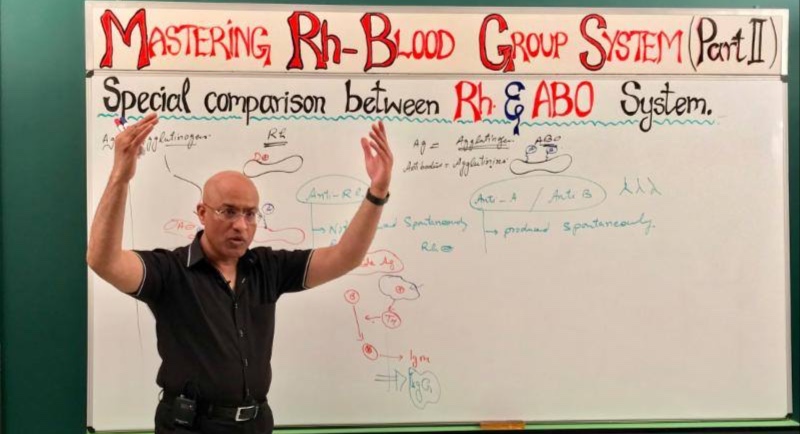
The immune system protects you from thousands of threats, and when it misfires it causes allergy, autoimmunity and transfusion reactions. Immunology feels difficult because the cast of cells and molecules is large, but Dr. Najeeb introduces them in the order they act. Across 56 hand-drawn lectures, you meet the organs and cells, follow an inflammatory response from start to finish, then study the adaptive response, antibodies, hypersensitivity and blood groups. The course is taught by a teacher with over 40 years of experience.
| At a glance | Immunology |
|---|---|
| Teacher | Dr. Najeeb, over 40 years of teaching experience |
| Number of lectures | 56 video lecture parts in 6 modules |
| How it is taught | Live whiteboard drawing, one idea at a time |
| Where to begin | No background needed; the lectures begin with the cells and organs of immunity |
| Plan | Lifetime access with the premium plan, future lectures included |
| Handwritten notes | Handwritten notes for every lecture, sold separately (Notes add-on or Combo Plan) |
| Sample lectures | Sample lectures through a free “Try Us Free” account |
| Suited to | Medical, dental, nursing, pharmacy and laboratory students; USMLE Step 1, PLAB, COMLEX and NEET PG candidates |
A clearer way into immunology
Immunology becomes manageable when each cell and molecule is introduced with its job. These lectures do exactly that.
- Immune organs and cells are taught first, so later topics have a clear cast.
- Inflammation is drawn as a sequence, from vascular events to selectins and cytokines.
- MHC, antibodies and T and B cell help are linked, so the adaptive response reads as one pathway.
- Hypersensitivity types are explained by mechanism, which makes them easy to separate.
- Handwritten notes for every lecture give you a clear revision set.
Topics at the heart of the course
- Describe the primary and secondary lymphoid organs and their roles
- Explain leukocyte recruitment and the early events of inflammation
- Describe the complement pathways and their functions
- Explain how MHC molecules present antigen
- Describe B cell activation, T helper help and antibody classes
- Explain the main cytokines and their effects
- Distinguish the four types of hypersensitivity reaction
- Explain ABO and Rh immunology and the laboratory tests that detect antigen-antibody reactions
From lecture hall to ward
- Allergy and anaphylaxis
- Autoimmune hemolytic anemia
- Transfusion reactions
- Immune complex disease
- Delayed-type hypersensitivity
- Immune deficiency
- Infection and the inflammatory response
Step-by-step outline (56 parts)
| Module | Topics (number of lecture parts) | Parts |
|---|---|---|
| 1. Immune cells and organs | Bone Marrow and Hematopoiesis (2); White Blood Cells (3); Thymus and T-cell Development (2); Lymph Nodes (2); Spleen (2) | 11 |
| 2. Innate immunity and inflammation | Inflammation, Vascular Events (4); Margination (1); Rolling (1); Selectins (1); Complement System (3); Cytokines (4) | 14 |
| 3. Adaptive immunity | MHC Molecules (4); B Lymphocytes and TH2 Lymphocytes (2); Antibodies, Immunoglobulins (3) | 9 |
| 4. Hypersensitivity reactions | Type 1 (2); Type 2 (1); Type 3 (2); Type 4 (2) | 7 |
| 5. Blood groups and laboratory tests | ABO Blood Group System (3); Anti-RBC Antibodies and Coombs Test (3); Rh Blood Group System (3); ELISA (1); Antigen-Antibody Reactions in the Laboratory (1) | 11 |
| 6. Microbial oxygen requirements | Obligate Anaerobes, Aerotolerant Anaerobes, Facultative Anaerobes, Microaerophiles and Obligate Aerobes (4) | 4 |
Total: 56 lecture parts.
Who this course serves best
- First-year medical students beginning immunology
- Pharmacy, nursing and laboratory students who need clear explanations of immune responses
- Anyone revising hypersensitivity and antibodies before an exam
- Candidates preparing for USMLE Step 1, PLAB, COMLEX or NEET PG
If the immune system has always felt like a crowd of unfamiliar names, start with the cells and organs module.
A study plan that works
- Learn the immune cells and organs before moving to inflammation.
- Draw the leukocyte recruitment sequence and the complement pathways from memory.
- Study MHC, B cells and antibodies as a single pathway.
- Make a one-line mechanism card for each hypersensitivity type and revise from the handwritten notes.
Related courses in the Video Library: Blood Physiology for white cells, blood groups and the Coombs test, Hematopoietic and Lymphoid Pathology for blood disorders with an immune basis, Microbiology for the organisms the immune system fights, General Pathology for inflammation and tissue injury and Histology for the thymus, lymph nodes and spleen in tissue.
Key immunology concepts in a minute
What is the difference between innate and adaptive immunity?
Innate immunity is fast and nonspecific, using barriers, phagocytes and complement. Adaptive immunity is slower and specific, relies on T and B lymphocytes and produces memory.
What is the difference between MHC class I and class II?
MHC class I is present on all nucleated cells and presents antigen to CD8 T cells. MHC class II is found on antigen-presenting cells and presents antigen to CD4 T cells.
What are the main antibody classes?
The main classes are IgG, IgA, IgM, IgE and IgD. IgG is the most abundant in serum, IgA protects mucosal surfaces, IgM is the first antibody made in a response and IgE mediates allergy.
How does the complement system work?
Complement is activated through the classical, alternative or lectin pathways. All converge on C3 convertase, producing opsonins, anaphylatoxins and the membrane attack complex that lyses target cells.
What are the four types of hypersensitivity?
Type 1 is immediate IgE-mediated, type 2 involves antibodies against cell surface antigens, type 3 is caused by immune complexes and type 4 is a delayed T cell-mediated response.
What do cytokines do?
Cytokines are signaling proteins that coordinate immune responses. Interleukin-2 supports T cell growth, interferon-gamma activates macrophages and tumor necrosis factor drives inflammation.
How does ELISA work?
ELISA uses an antibody linked to an enzyme to detect an antigen or antibody. A color change after adding substrate shows that the target is present, and the intensity reflects its amount.
Questions students ask most
Do I need prior knowledge before starting immunology?
No. The course starts with the cells and organs of immunity and builds one idea at a time, so a beginner can follow it. If you already know the basics, it works well as a rapid revision of hypersensitivity and antibodies.
How many immunology lectures can I watch?
The course contains 56 lecture parts organized into 6 modules.
Which topics does the immunology course cover?
It covers immune cells and organs, inflammation, complement, cytokines, MHC molecules, B and T helper cells, antibodies, the four hypersensitivity types, the ABO and Rh blood groups, the Coombs test, ELISA and laboratory antigen-antibody reactions.
Can I try some lectures before I buy?
Yes. Sign up for a free Try Us Free account, watch the sample lectures, then decide whether to upgrade.
Do the lectures come with notes?
Yes. Handwritten notes are available for every lecture in this course. They are sold separately through the Notes add-on or the Combo Plan.
How long do I keep access to the lectures?
With the premium plan you keep access permanently, and new lectures are included at no extra cost.
Can I watch the lectures offline?
Offline access is limited to the official Dr. Najeeb Lectures app, and the videos cannot be saved as standalone files.
Will this course help with USMLE, PLAB, COMLEX or NEET PG?
It covers the immunology content that these exams test. It does not include a question bank or a certificate.
Can I get a refund?
Refunds are available within 7 days. Email support@drnajeeblectures.com and the team will help.