Histology
Histology has a reputation: endless slides, odd stains and Latin names that refuse to stay in your head. Dr. Najeeb’s Histology course takes a different route. Across 47 hand-drawn video lectures, he explains why each tissue looks the way it does, so you can read a slide instead of memorizing it. The histology lectures run from the cell membrane and epithelium through blood, the immune organs, the heart and vessels, the liver and the retina, taught by a teacher with over 40 years of experience.
| At a glance | Histology |
|---|---|
| Taught by | Dr. Najeeb, over 40 years of teaching experience |
| Lectures | 47 video lecture parts in nine modules |
| Format | Live whiteboard drawing, one idea at a time |
| Starting point | No background needed; the lectures begin with the basics |
| Membership | Lifetime access with the premium plan, future lectures included |
| Study notes | Handwritten notes for every lecture, sold separately (Notes add-on or Combo Plan) |
| Try first | Sample lectures through a free “Try Us Free” account |
| Best for | Medical, dental, nursing, pharmacy and physiotherapy students; USMLE Step 1, PLAB, COMLEX and NEET PG candidates |
Why this histology course is easier to follow
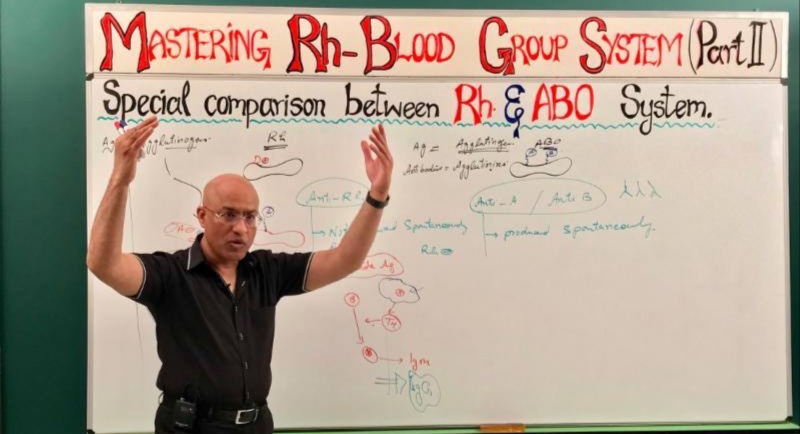
Most histology resources show you a finished slide and ask you to remember it. Here you watch the tissue being built, step by step, and each layer is tied to the job it does.
- Structure follows function: every tissue is explained through what it has to do, so the appearance makes sense.
- You see the diagram appear line by line, which makes it easy to redraw from memory.
- Clinical links, such as blood group matching and clotting, show why histology matters beyond the exam hall.
- Handwritten notes for every lecture give you a clean page to revise from.
What you will learn in these histology lectures
- How the cell membrane controls what enters and leaves a cell
- How epithelium and connective tissue are built and classified
- Where collagen comes from and why vitamin C matters
- How blood cells are formed, shaped and recognized
- How ABO and Rh blood groups explain transfusion reactions and newborn disease
- How the thymus, lymph nodes and spleen build immunity
- What blood vessels, the liver, the gut and the pancreas look like under the microscope
- How the layers of the retina are arranged
Clinical links you will meet along the way
- Scurvy and other problems of collagen formation
- Anemia and the role of red blood cells
- Bleeding and clotting disorders
- Transfusion reactions and ABO matching
- Rh incompatibility and hemolytic disease of the newborn
- Immune deficiency and T-cell maturation
- Liver sinusoids and the blood flow of the liver
- Lymph node and spleen function during infection
Histology lecture roadmap: 47 parts in nine modules
| Module | Topics (number of lecture parts) | Parts |
|---|---|---|
| 1. Cell membrane and transport | Cell Membrane (2); Membrane Transport Mechanisms (2) | 4 |
| 2. Basic tissues | Epithelium (2); Connective Tissue: Basic Concepts (2); Adipocytes (2); Collagen Fiber Synthesis (3) | 9 |
| 3. Nervous tissue | Histology of the Nervous System (1) | 1 |
| 4. Blood and bone marrow | Bone Marrow and Hematopoiesis (2); Red Blood Cells (2); White Blood Cells (3); Platelets and Coagulation System (2) | 9 |
| 5. Blood groups | ABO Blood Group System (3); Rh Blood Group System (3) | 6 |
| 6. Immune organs | Thymus and T-cell Development (2); Lymph Nodes (2); Spleen (2) | 6 |
| 7. Cardiovascular system | Histology of the Cardiovascular System (4) | 4 |
| 8. Liver, gut and pancreas | Histology of the Liver (2); GI Histology: Basic Concepts (1); Histology of the Pancreas (1) | 4 |
| 9. The eye | Structure of the Eye Ball (1); Retina: Introduction, Cells and Layers, Important Points (3) | 4 |
Total: 47 lecture parts.
Is this histology course right for you?
- First-year medical students meeting histology for the first time
- Dental, nursing, pharmacy and physiotherapy students who need clear tissue basics
- Anyone revising before a histology practical or written exam
- Candidates preparing for USMLE Step 1, PLAB, COMLEX or NEET PG
Whether you are starting from zero or tidying up gaps, you can begin with the very first lecture.
A simple plan to get the most from the lectures
- Watch one lecture at a time, pause, and sketch the diagram from memory.
- Name the function of each layer before you name the cell.
- Read the handwritten notes the same day for quick revision.
- Study the blood and immune modules together, since they share the same cells and ideas.
Keep the momentum going with Embryology to see how these tissues develop, Membrane Physiology and Blood Physiology to see how they function, and the Eye Anatomy & Physiology course to go deeper into the retina. To connect structure with function and disease, continue with Vascular Pathology for the vessel wall in disease, Immunology for the lymphoid organs, Blood Physiology and Hematopoietic and Lymphoid Pathology for blood cells and marrow, GI and Hepatobiliary Physiology for the liver and gut, and General Pathology for how tissues respond to injury.
Histology quick answers
What are the four basic tissue types?
The four basic tissues are epithelial, connective, muscle and nervous tissue. This course teaches epithelium, connective tissue and the histology of the nervous system in detail.
How is epithelium classified?
Epithelium is classified by the number of cell layers (simple, stratified or pseudostratified) and by the shape of the surface cells (squamous, cuboidal or columnar). Together these two features give each epithelium its name.
How is collagen made?
Fibroblasts make procollagen on the rough endoplasmic reticulum. Proline and lysine are hydroxylated in a step that needs vitamin C, three chains form a triple helix, and after secretion the ends are cut off so the molecules assemble into fibrils. Without vitamin C this chain fails, which causes scurvy.
Where are blood cells made?
After birth, blood cells are made in the red bone marrow in a process called hematopoiesis. A hematopoietic stem cell gives rise to the myeloid and lymphoid lines, which produce red cells, white cells and platelets.
What does the thymus do?
The thymus is where T-cell precursors mature. Cells that recognize self too strongly or not at all are removed, so the T cells that leave are useful and tolerant of the body’s own tissues.
How do the ABO and Rh blood groups work?
In the ABO system, red cells carry A or B antigens (or neither), and the plasma contains antibodies against the antigens the person lacks. In the Rh system, the key antigen is D. An Rh-negative mother carrying an Rh-positive baby can form anti-D antibodies, which can cause hemolytic disease of the newborn in later pregnancies.
What are the three layers of a blood vessel wall?
The wall has three layers: the tunica intima (the inner lining), the tunica media (the middle muscular layer) and the tunica adventitia (the outer connective tissue layer).
What does a liver lobule look like?
A classic liver lobule is hexagonal, with a central vein in the middle and portal triads at the corners. Each triad holds a hepatic artery branch, a portal vein branch and a bile duct. Plates of hepatocytes run between them, separated by sinusoids.
Your questions, answered
Do I need any background to follow the histology lectures?
No. Every lecture begins with the basic idea and builds from there, so you can start the course with no prior medical knowledge. If you already know the basics, the lectures work well as a fast revision before exams.
How many histology lectures are included?
The course contains 47 lecture parts, starting with the cell membrane and ending with the four-part retina series.
Which histology topics does the course cover?
It covers the cell membrane and membrane transport, epithelium, connective tissue, adipocytes, collagen synthesis, the nervous system, bone marrow and blood cells, platelets and coagulation, the ABO and Rh blood groups, the thymus, lymph nodes and spleen, the cardiovascular system, the liver, the gastrointestinal tract, the pancreas and the eye.
Can I try a few lectures first?
Yes. Create a free Try Us Free account to watch sample lectures and see how Dr. Najeeb teaches before you choose a plan.
Do the lectures come with notes?
Yes. Handwritten notes are available for every lecture in this course. They are sold separately through the Notes add-on or the Combo Plan.
How long do I keep access to the lectures?
The premium plan gives you lifetime access, including any new lectures added to the library later.
Can I watch the histology lectures offline?
Offline viewing works only inside the official Dr. Najeeb Lectures app. The videos cannot be downloaded as separate files.
Will this course help with USMLE, PLAB, COMLEX or NEET PG?
It covers the histology and related basic science these exams test. It does not include a question bank or a certificate.
Can I get a refund?
Dr. Najeeb Lectures offers a 7-day refund. Email support@drnajeeblectures.com to request one.