Embryology
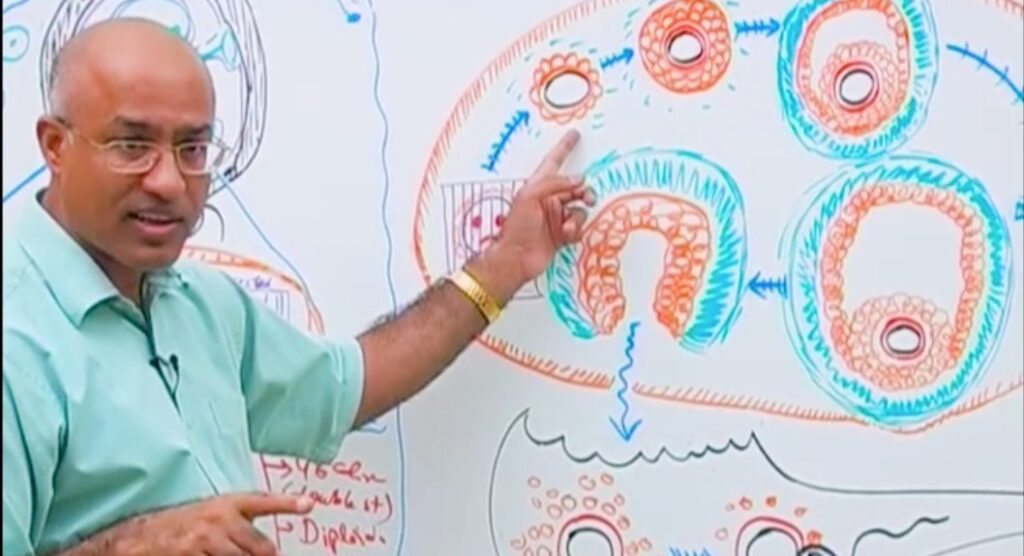
Dr. Najeeb’s Embryology course is a 28-part video lecture series that follows human development from meiosis and fertilization to the formation of the placenta and the major organ systems. Every lecture is a hand-drawn, step-by-step whiteboard lesson by Dr. Najeeb, who has over 40 years of teaching experience. It is built for medical, dental, nursing and physiotherapy students who want embryology explained through function and clinical cases instead of rote memorization.
| Course | Embryology |
|---|---|
| Instructor | Dr. Najeeb, over 40 years of teaching experience |
| Content | 28 lecture parts across six modules |
| Teaching style | Hand-drawn, step-by-step whiteboard lectures |
| Level | Beginner-friendly; no prior medical knowledge needed |
| Access | Lifetime access with the premium plan, including future lectures |
| Notes | Handwritten notes for every lecture, sold separately (Notes add-on or Combo Plan) |
| Free preview | Available through a free “Try Us Free” account |
| Suitable for | Medical, dental, nursing, pharmacy and physiotherapy students; USMLE Step 1, PLAB, COMLEX and NEET PG preparation |
What you will learn in the embryology course
The course follows the way embryology is tested and used in clinical practice: each stage of development is taught in order, with the reason it matters and what happens when it goes wrong.
- Meiosis, oogenesis and the cell cycle
- The female reproductive cycle and fertilization
- Development up to the second and third weeks, including the trilaminar disc
- The development of the placenta and fetal circulation
- The development of the vascular system
- The development of the nervous system
- Musculoskeletal development
- Linkage analysis and gene mapping
Clinical topics covered
The lectures keep returning to the clinical picture, so you learn the development together with the problems you will meet in patients.
- Errors of meiosis and cell division
- Implantation and the early weeks of pregnancy
- Placental development
- Fetal circulation and the changes at birth
- Congenital malformations of the vascular system
- Neural tube development and its defects
- Musculoskeletal malformations
- Genetic linkage and inheritance patterns
Course curriculum: 28 embryology lectures
| Module | Topics (number of lecture parts) | Parts |
|---|---|---|
| 1. Gametogenesis and cell division | Meiosis (1); Oogenesis (1); Cell Cycle and Genes (2) | 4 |
| 2. Female reproductive cycle and fertilization | Female Reproductive Cycle (2); Fertilization (2) | 4 |
| 3. Development up to the third week | Development up to the 2nd Week (2); Development up to the 3rd Week and the Trilaminar Disc (3) | 5 |
| 4. Placenta and fetal circulation | Development of the Placenta (2); Fetal Circulation (1) | 3 |
| 5. Development of organ systems | Development of the Vascular System (4); Development of the Nervous System (2); Musculoskeletal Development (3) | 9 |
| 6. Genetics: linkage analysis | Linkage Analysis (3) | 3 |
Total: 28 lecture parts.
Who this course is for
- Medical students (MBBS, MD) learning embryology for the first time
- Dental students who need the basics of human development
- Nursing, pharmacy and physiotherapy students
- Candidates preparing for USMLE Step 1, PLAB, COMLEX or NEET PG
No prior medical knowledge is needed. Each topic begins with the basic idea and builds up with diagrams.
How to study with this course
- Start with meiosis and oogenesis, then follow development week by week in order.
- Watch each lecture with a blank page and redraw the diagram as Dr. Najeeb draws it.
- Use the handwritten notes for revision after you finish each module.
- Connect each stage of development to its clinical problem, as the lectures do, to remember it for exams.
Pair this course with Histology for the tissues that form, the Neuro Anatomy & Neuro Physiology course for the nervous system, Gross Anatomy Head and Neck for the cranial nerves, and the Upper Limb and Lower Limb courses for musculoskeletal anatomy. To see development in context, continue with Cardiac Pathology for congenital heart disease, Lower Limb and Surgery for the anatomy of the inguinal region, Molecular Biology, Genetics and Biochemistry for the genetics of developmental disorders and Cardiac Physiology for the fetal and adult circulation.
Embryology in brief
What happens in the first three weeks of embryonic development?
In week 1 the egg is fertilized, divides and forms a blastocyst that begins implanting. In week 2 implantation is completed and the bilaminar disc forms from the epiblast and hypoblast. In week 3 gastrulation creates the trilaminar disc of ectoderm, mesoderm and endoderm.
Where does fertilization occur?
Fertilization occurs in the ampulla of the uterine tube. The sperm must first undergo capacitation and the acrosome reaction, and after one sperm enters the egg the zona reaction blocks other sperm.
What is the difference between spermatogenesis and oogenesis?
In oogenesis, primary oocytes start meiosis before birth and stay arrested in prophase I until puberty. At ovulation the secondary oocyte is arrested in metaphase II and completes meiosis only if it is fertilized. Spermatogenesis makes four sperm per cell, while oogenesis makes one ovum and polar bodies.
What does each germ layer become?
The ectoderm forms the nervous system and the epidermis of the skin. The mesoderm forms muscle, bone, the heart and blood vessels. The endoderm forms the lining of the gut and the organs that develop from it.
What is the function of the placenta?
The placenta handles gas exchange, nutrient supply and waste removal between mother and fetus, and it makes hormones such as hCG and progesterone. It forms from the fetal chorion frondosum and the maternal decidua basalis.
How does fetal circulation work?
Oxygenated blood from the placenta flows to the fetus through the umbilical vein. The ductus venosus bypasses most of the liver, and the foramen ovale and ductus arteriosus bypass the lungs. Two umbilical arteries return deoxygenated blood to the placenta.
How does the neural tube form?
The notochord induces the overlying ectoderm to form the neural plate, which folds into the neural tube during neurulation in weeks 3 and 4. Failure of the tube to close causes neural tube defects such as spina bifida and anencephaly.
What is linkage analysis?
Linkage analysis tests whether two genes on the same chromosome are inherited together. The recombination frequency shows how far apart they are, and a LOD score of 3 or more is taken as evidence of linkage.
Questions about this course
Is the Dr. Najeeb embryology course suitable for beginners?
Yes. Each lecture starts from the basics and builds step by step with hand-drawn diagrams, so no prior medical knowledge is needed. Students who already know the basics can use the course to revise the first three weeks, the placenta, fetal circulation and organ development.
How many lectures are in the Embryology course?
The course has 28 lecture parts, from meiosis and oogenesis to the three-part series on linkage analysis.
What topics does the embryology course cover?
It covers meiosis, oogenesis, the cell cycle and genes, the female reproductive cycle, fertilization, development up to the third week (including the trilaminar disc), the development of the placenta, fetal circulation, the development of the vascular, nervous and musculoskeletal systems, and linkage analysis.
Can I watch a free sample before I sign up?
Yes. A free “Try Us Free” account gives you access to sample lectures, so you can see the teaching style before you decide on a plan.
Are notes available for the embryology lectures?
Handwritten notes are available for every lecture in this course. They are sold separately through the Notes add-on or the Combo Plan.
Do I get lifetime access?
Yes. The premium plan gives lifetime access to the lectures, including future lectures added to the library.
Can I download the lectures for offline viewing?
Offline viewing is available only through the official Dr. Najeeb Lectures app. The lectures cannot be downloaded as files.
Is this course useful for USMLE, PLAB, COMLEX or NEET PG?
Yes, for the embryology and genetics topics that these exams test. The course does not include a question bank or a certificate.
What is the refund policy?
Dr. Najeeb Lectures offers a 7-day refund. To request one, email support@drnajeeblectures.com.