
ECG Series (EKG)
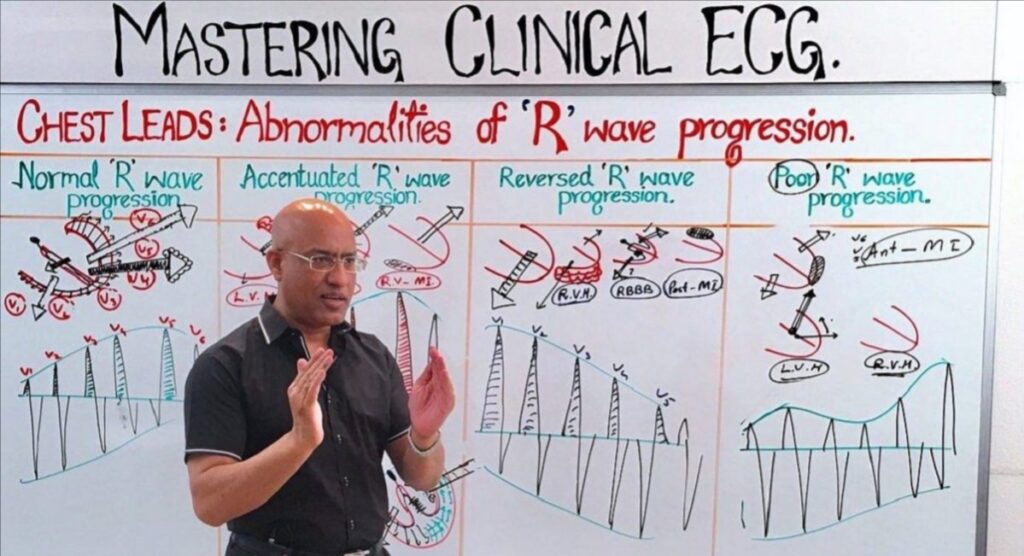
An ECG is not a picture to memorize but a recording to understand. Each wave, each lead and each deflection has a reason. Dr. Najeeb’s ECG Series begins with the electrical activity of the heart, builds the leads one by one and explains the QRS complex until the direction of every deflection can be reasoned out. In 15 hand-drawn lectures, you finish with a systematic method for reading an EKG. The course is taught by a teacher with over 40 years of experience.
| At a glance | ECG Series (EKG) |
|---|---|
| Teacher | Dr. Najeeb, over 40 years of teaching experience |
| Number of lectures | 15 video lecture parts in 4 modules |
| How it is taught | Live whiteboard drawing, one idea at a time |
| Where to begin | No background needed; the lectures begin with cardiac electrophysiology |
| Plan | Lifetime access with the premium plan, future lectures included |
| Handwritten notes | Handwritten notes for 13 of the 15 lectures, sold separately (Notes add-on or Combo Plan) |
| Sample lectures | Sample lectures through a free “Try Us Free” account |
| Suited to | Medical, nursing, paramedic and physiotherapy students; junior doctors; USMLE, PLAB, COMLEX and NEET PG candidates |
Learn ECG by understanding, not memorizing
Learning the ECG as a set of patterns leads to confusion on the first unfamiliar tracing. Learning the reasoning behind it does not.
- Leads are built from the heart’s electrical axis, so a deflection can be predicted.
- The QRS complex is taught in limb and chest leads, with the variants explained.
- R wave progression is explained as the product of the electrical vector, not as a rule.
- A systematic interpretation method makes reading a tracing quick.
- Handwritten notes cover 13 of the 15 lectures.
By the end you will understand
- Explain the electrical basis of the ECG
- Describe bipolar limb leads, augmented unipolar leads and chest leads
- Name the components of the QRS complex
- Explain QRS patterns in limb and chest leads
- Recognize abnormal R wave progression
- Interpret an ECG using a systematic method
Real-world and exam relevance
- Reading an ECG in an emergency
- Axis deviation
- Abnormal R wave progression
- Conduction abnormalities
- Rhythm disturbances
- Chamber enlargement
Course map: 15 lecture parts, module by module
| Module | Topics (number of lecture parts) | Parts |
|---|---|---|
| 1. Electrophysiology | Electro-Physiology of the Heart (2) | 2 |
| 2. The leads | Bipolar Limb Leads (2); Augmented Unipolar Limb Leads (1); Chest Leads (1) | 4 |
| 3. The QRS complex | QRS Nomenclature (1); QRS in Chest Leads (1); QRS Variants in Limb Leads (2); Abnormalities of R Wave Progression (1) | 5 |
| 4. Interpretation | EKG Interpretation (4) | 4 |
Total: 15 lecture parts.
Built for these learners
- Medical students learning the ECG for the first time
- Nursing, paramedic and physiotherapy students who need confident ECG reading
- Junior doctors revising before clinical rotations
- Candidates preparing for USMLE, PLAB, COMLEX or NEET PG
If you have been told to learn the ECG by looking at many tracings, this series gives you the reasoning that makes those tracings make sense.
Study tips built into the course design
- Watch the electrophysiology lectures before the leads.
- Draw the lead axes and the heart vector until it is automatic.
- Practice the interpretation method on real tracings after each lecture.
- Review from the handwritten notes.
Study ECG Series (EKG) alongside Cardiac Physiology for the cardiac cycle and heart sounds, Cardiac Pathology for the diseases that change the ECG, Clinical Medicine for ECG lectures with bedside cardiology, Membrane Physiology for the action potential behind the waves and Pharmacology for antiarrhythmic drugs.
ECG Series (EKG) in brief
What does a normal sinus rhythm look like?
Each QRS complex is preceded by a P wave and the rate is between 60 and 100 beats per minute. The rhythm is regular and the P wave is upright in lead II.
What are the normal ECG intervals?
The PR interval is 0.12 to 0.20 seconds and the QRS duration is less than 0.12 seconds. The QT interval varies with heart rate and is usually corrected for it.
What are the standard ECG leads?
The 12-lead ECG has six limb leads (I, II, III, aVR, aVL, aVF) and six chest leads (V1 to V6), which view the heart from different angles.
What is R wave progression?
In the chest leads, the R wave grows from V1 to V5 or V6 while the S wave shrinks. The transition, where R equals S, is normally in V3 or V4.
How do you calculate heart rate from an ECG?
For a regular rhythm, divide 300 by the number of large squares between two R waves, or use 1500 divided by the number of small squares.
Why does the QRS complex point up in some leads and down in others?
The direction of the deflection depends on whether the net electrical vector of ventricular depolarization moves toward or away from the positive pole of that lead.
Your questions, answered
Do I need prior knowledge before starting ECG?
No. The series begins with the electrical basis of the ECG, so a beginner can follow it. If you already read ECGs, it works as a structured revision.
How many ECG lectures can I watch?
The series contains 15 lecture parts organized into four modules.
Which topics does the ECG course cover?
It covers cardiac electrophysiology, bipolar and augmented limb leads, chest leads, QRS nomenclature, QRS in limb and chest leads, R wave progression and systematic EKG interpretation.
Can I try some lectures before I buy?
Yes. Sign up for a free Try Us Free account, watch the sample lectures, then decide whether to upgrade.
Do the lectures come with notes?
Handwritten notes are available for 13 of the 15 lectures in this series. They are sold separately through the Notes add-on or the Combo Plan.
How long do I keep access to the lectures?
With the premium plan you keep access permanently, and new lectures are included at no extra cost.
Can I watch the lectures offline?
Offline access is limited to the official Dr. Najeeb Lectures app, and the videos cannot be saved as standalone files.
Will this course help with USMLE, PLAB, COMLEX or NEET PG?
It covers the ECG content that these exams test. It does not include a question bank or a certificate.
Can I get a refund?
Refunds are available within 7 days. Email support@drnajeeblectures.com and the team will help.