
Endocrine Physiology
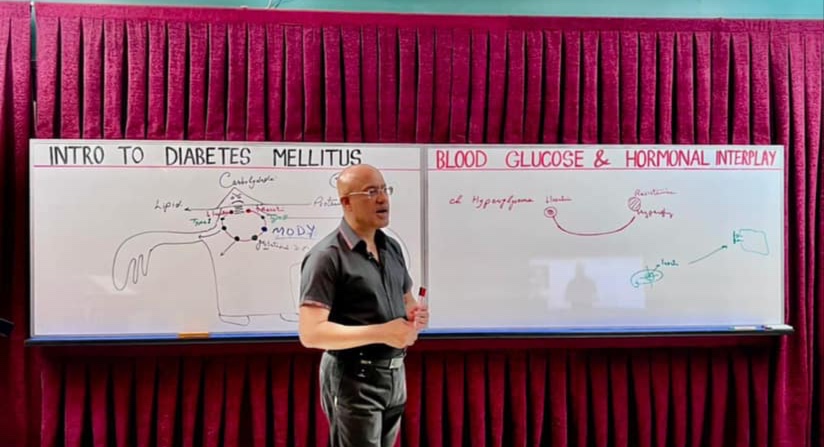
Hormones are the body’s slowest and most powerful messages, and endocrine physiology is the subject that explains how they are made, released, received and switched off. Dr. Najeeb teaches it as a chain of cause and effect: a signal arrives, a receptor responds, a pathway runs, and a cell changes what it does. Across 77 hand-drawn lectures, you follow insulin, the catecholamines, the pituitary hormones, the thyroid, the parathyroid and the steroids from synthesis to clinical consequence. The course is taught by a teacher with over 40 years of experience.
| At a glance | Endocrine Physiology |
|---|---|
| Taught by | Dr. Najeeb, over 40 years of teaching experience |
| Lectures | 77 video lecture parts in 7 modules |
| Format | Live whiteboard drawing, one idea at a time |
| Starting point | No background needed; the lectures begin with insulin synthesis and secretion |
| Membership | Lifetime access with the premium plan, future lectures included |
| Study notes | Handwritten notes for 63 of the 77 lectures, sold separately (Notes add-on or Combo Plan) |
| Try before you buy | Sample lectures through a free “Try Us Free” account |
| Best for | Medical, dental, nursing and pharmacy students; USMLE Step 1, PLAB, COMLEX and NEET PG candidates |
Why Endocrine Physiology feels easier here
Endocrinology rewards a mechanism-first approach. When you know how a hormone is made and how its receptor signals, the diseases follow almost on their own.
- Insulin gets the depth it deserves, from secretion and receptor signaling to its effects on carbohydrate, fat and potassium.
- Receptor types and intracellular signaling are taught once, clearly, then reused across hormones.
- Thyroid, parathyroid and steroid hormones are drawn from synthesis to effect, which turns lists into logic.
- Diabetic ketoacidosis is explained as a consequence of absolute insulin deficiency, not as a separate fact to memorize.
- Handwritten notes cover 63 of the 77 lectures.
What you will be able to do after this course
- Describe how insulin is synthesized, secreted and cleared
- Explain insulin receptor signaling and its metabolic effects
- Contrast hexokinase with glucokinase and lipoprotein lipase with hormone-sensitive lipase
- Explain why diabetic ketoacidosis develops and how potassium behaves
- Describe catecholamine synthesis, storage, release and action
- Explain how the anterior and posterior pituitary hormones are controlled
- Describe thyroid hormone synthesis and action
- Explain parathyroid hormone and calcium regulation
- Outline steroid hormone biosynthesis
Where endocrine physiology meets the clinic
- Type 1 and type 2 diabetes mellitus
- Hyperglycemia and hypoglycemia
- Diabetic ketoacidosis
- Thyroid disorders
- Disorders of calcium and parathyroid function
- Diabetes insipidus and the role of ADH
- Pheochromocytoma and catecholamine excess
Lecture roadmap: 77 parts in 7 modules
| Module | Topics (number of lecture parts) | Parts |
|---|---|---|
| 1. Insulin and glucose homeostasis | Insulin Synthesis and Secretion (4); Insulin Receptors and Transduction Pathways (4); Summary of Insulin Receptor Signaling (1); Introduction to Diabetes Mellitus (2); Importance of Normal Blood Glucose (2); Fed State and the Liver (2); Glucose Transport, GLUTs (8) | 23 |
| 2. Metabolic actions of insulin | Effects on Carbohydrates (3); Lipogenesis and Fat Storage (2); Hexokinase vs Glucokinase (2); Lipoprotein Lipase vs Hormone-Sensitive Lipase (2); Insulin and Serum Potassium (2) | 11 |
| 3. Insulin deficiency | Lipolysis and Ketogenesis (3); Diabetic Ketoacidosis (2); Transport of Ketone Bodies and Ketolysis (2) | 7 |
| 4. Autonomic and catecholamine physiology | A.N.S., Epinephrine and Norepinephrine (7); Catecholamine Synthesis, Storage and Release (4) | 11 |
| 5. Receptors and the pituitary | Receptors and Intracellular Signaling (5); Anterior Pituitary and Growth Hormone (3); Posterior Pituitary, ADH (2) | 10 |
| 6. Thyroid, parathyroid and steroids | Physiology of Thyroid Hormone (5); Parathyroid Hormone (6); Steroid Hormone Biosynthesis (3) | 14 |
| 7. Hormone measurement | ELISA Test: Direct, Indirect and Sandwich (1) | 1 |
Total: 77 lecture parts.
Is this course for you?
- Medical students meeting endocrine physiology for the first time
- Pharmacy and nursing students who need to understand diabetes and hormone action
- Anyone revising insulin signaling and metabolism before an exam
- Candidates preparing for USMLE Step 1, PLAB, COMLEX or NEET PG
If hormones have always felt like a list of names, start with the insulin lectures and the logic will appear.
How to get the most from it
- Begin with insulin, because it introduces receptors, signaling and metabolism in one story.
- Redraw each signaling pathway from memory before moving to the next hormone.
- Study the pituitary, thyroid and parathyroid lectures as feedback loops, not lists.
- Review each module from the handwritten notes where they are available.
To see the bigger picture, continue with Diabetes Mellitus for a dedicated insulin and diabetes collection, Molecular Biology, Genetics and Biochemistry for the biochemistry behind hormone action, Pharmacology for drugs acting on adrenergic and hormonal pathways, Renal Physiology for aldosterone, ADH and sodium balance and Neuro Anatomy and Neuro Physiology for the autonomic nervous system.
Endocrine Physiology: quick answers
How is insulin secreted?
Glucose enters the beta cell through GLUT2 and is phosphorylated by glucokinase. Rising ATP closes ATP-sensitive potassium channels, the cell depolarizes, calcium enters through voltage-gated channels and insulin granules are released by exocytosis.
How does the insulin receptor signal?
The insulin receptor is a receptor tyrosine kinase. It phosphorylates insulin receptor substrates, activating the PI3 kinase and Akt pathway, which moves GLUT4 to the cell surface in muscle and fat, while a separate MAP kinase pathway drives growth effects.
What is the difference between hexokinase and glucokinase?
Hexokinase has a low Km and is inhibited by its product, glucose-6-phosphate. Glucokinase, found in liver and beta cells, has a high Km and is not inhibited by glucose-6-phosphate, so it senses and responds to high blood glucose.
Why does diabetic ketoacidosis occur?
Absolute insulin deficiency allows unrestrained lipolysis and hepatic ketone production, together with hyperglycemia. The accumulating ketoacids cause an anion gap metabolic acidosis, and total body potassium is depleted even when serum potassium appears normal.
Why does insulin lower serum potassium?
Insulin stimulates the sodium-potassium ATPase in skeletal muscle and other cells, moving potassium into cells. This is why insulin with glucose is used to treat hyperkalemia.
How is thyroid hormone made?
Iodide is trapped by the thyroid follicular cell, oxidized by thyroid peroxidase and attached to tyrosine residues on thyroglobulin. Coupling forms T4 and T3. T4 is secreted in larger amounts, and T3 is the more active hormone.
What does parathyroid hormone do?
Parathyroid hormone raises serum calcium by increasing bone resorption, increasing renal calcium reabsorption and stimulating activation of vitamin D. It also lowers phosphate reabsorption in the proximal tubule.
Where do steroid hormones come from?
All steroid hormones are synthesized from cholesterol. The rate-limiting step is the transport of cholesterol into mitochondria, followed by conversion to pregnenolone by the side-chain cleavage enzyme.
Frequently asked questions
Do I need prior knowledge before starting endocrine physiology?
No. The course starts with insulin synthesis and secretion and builds step by step, so a beginner can follow it. If you already know the basics, it works well as a rapid revision of signaling and the major endocrine glands.
How many lectures are in the endocrine physiology course?
The course contains 77 lecture parts organized into 7 modules.
Which topics does the endocrine physiology course cover?
It covers insulin synthesis, secretion and signaling, glucose transport, metabolic effects of insulin, diabetic ketoacidosis, catecholamines, receptors, the anterior and posterior pituitary, thyroid hormone, parathyroid hormone, steroid biosynthesis and the ELISA test.
Can I try some lectures before I buy?
Yes. Create a free Try Us Free account to watch sample lectures and see how Dr. Najeeb teaches before you choose a plan.
Do the lectures come with notes?
Handwritten notes are available for 63 of the 77 lectures in this course. They are sold separately through the Notes add-on or the Combo Plan.
How long do I keep access to the lectures?
The premium plan gives you lifetime access, including any new lectures added to the library later.
Can I watch the lectures offline?
Offline viewing works only inside the official Dr. Najeeb Lectures app. The videos cannot be downloaded as separate files.
Will this course help with USMLE, PLAB, COMLEX or NEET PG?
It covers the endocrine physiology content that these exams test. It does not include a question bank or a certificate.
Can I get a refund?
Dr. Najeeb Lectures offers a 7-day refund. Email support@drnajeeblectures.com to request one.