
Clinical Medicine
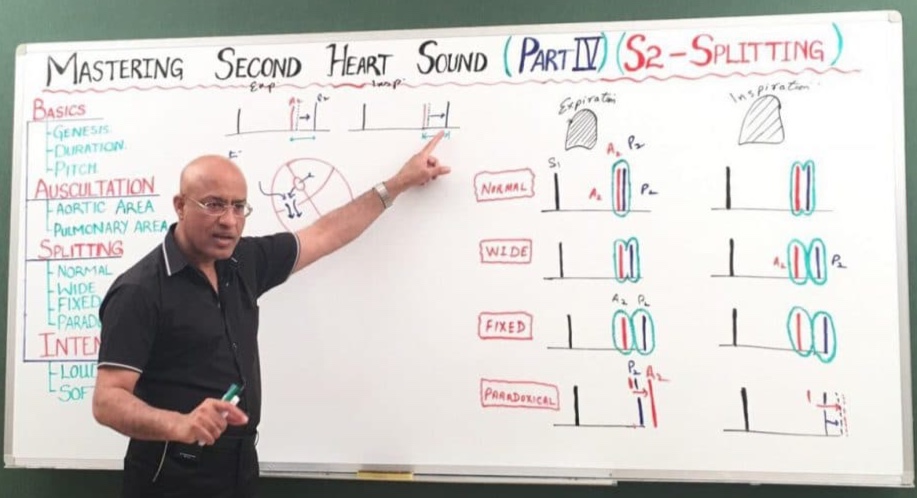
Textbooks teach disease. Clinical medicine teaches the patient in front of you. Dr. Najeeb’s Clinical Medicine course gathers the topics where understanding the mechanism changes what you do at the bedside: the ECG and the heart sounds, pericardial disease and tamponade, spinal cord and cranial nerve syndromes, diabetic emergencies, rheumatic fever and infection. Across 130 hand-drawn lectures, each sign is traced back to the structure or physiology that produces it. The course is taught by a teacher with over 40 years of experience.
| At a glance | Clinical Medicine |
|---|---|
| Instructor | Dr. Najeeb, over 40 years of teaching experience |
| Course length | 130 video lecture parts in 5 modules |
| Teaching style | Live whiteboard drawing, one idea at a time |
| Prior knowledge | Best after the basic science courses; each lecture explains its own background |
| Access | Lifetime access with the premium plan, future lectures included |
| Notes | Handwritten notes for 122 of the 130 lectures, sold separately (Notes add-on or Combo Plan) |
| Free preview | Sample lectures through a free “Try Us Free” account |
| Ideal for | Medical students in the clinical years; USMLE Step 1 and Step 2, PLAB, COMLEX and NEET PG candidates |
What makes this clinical medicine course different
Clinical reasoning is built on mechanism. These lectures show how a finding on examination follows from anatomy, physiology or pathology.
- Cardiology is taught from ECG leads to heart sounds to pericardial disease, so findings link together.
- Neurology syndromes are drawn from the anatomy, which makes localization logical.
- Diabetes and infection are taught through the physiology and pharmacology that guide treatment.
- Bedside signs such as Horner syndrome and the apex beat are explained step by step.
- Handwritten notes cover 122 of the 130 lectures.
Skills and knowledge you will gain
- Read ECG leads, QRS patterns and R wave progression
- Interpret heart sounds, murmurs and the jugular venous pulse
- Recognize acute pericarditis, constrictive pericarditis and cardiac tamponade
- Localize spinal cord and cranial nerve lesions such as Brown-Sequard syndrome, syringomyelia and Horner syndrome
- Distinguish bulbar from pseudobulbar palsy and describe motor neuron disease
- Explain diabetic ketoacidosis and the metabolic effects of insulin
- Describe rheumatic fever and its management
- Explain anaerobic infections and the antibiotics used for them
Clinical connections along the way
- Pericarditis and tamponade
- Rheumatic fever and rheumatic heart disease
- Cystic fibrosis
- Trigeminal neuralgia
- Syringomyelia and Brown-Sequard syndrome
- Diabetic ketoacidosis
- Paraneoplastic syndromes and Pancoast tumor
- Hypertensive retinopathy
Inside the course: 130 lectures in 5 modules
| Module | Topics (number of lecture parts) | Parts |
|---|---|---|
| 1. ECG, heart sounds and bedside cardiology | Mastering ECG Leads, QRS and R Wave Progression (7); QRS Variants in Limb Leads (2); Wolff-Parkinson-White Syndrome (2); Heart Sounds, Clicks and Murmurs (12); Jugular Venous Pulse (2); Apex Beat, Mitral Stenosis Sounds and PV Loop (4) | 29 |
| 2. Pericardial and rheumatic disease | Cardiac Tamponade (5); Acute Pericarditis (5); Constrictive Pericarditis (3); Rheumatic Fever and Rheumatic Heart Disease (4) | 17 |
| 3. Neurology and neuro-ophthalmology | Trigeminal Neuralgia (4); Syringomyelia (3); Motor Neuron Diseases (2); Bulbar and Pseudobulbar Palsy (2); Brown-Sequard Syndrome (1); Horner Syndrome and the Oculosympathetic Pathway (3); Hypertensive Retinopathy (3) | 18 |
| 4. Diabetes, insulin and signaling | Intro to Diabetes, Normal Glucose and Fed State (6); Insulin Synthesis, Receptors and Signaling (9); Insulin Effects and Metabolism (12); Diabetic Ketoacidosis and Ketones (4); Glucagon (1); Insulin and Potassium (2); G Protein-Coupled Receptors and Agonists (3) | 37 |
| 5. Infection, oncology and lung disease | Metronidazole (1); Anaerobes, Clindamycin and Aminoglycosides (12); Neutrophils in Acute Inflammation (1); Cystic Fibrosis (4); Pancoast Tumor (1); Paraneoplastic Syndromes (1); Mastering Edema (3); Osteomyelitis (3); ELISA (1); Cervical Lymph Node Levels (2) | 29 |
Total: 130 lecture parts.
Who benefits most
- Clinical-year medical students preparing for ward rotations
- Junior doctors who want to revisit mechanisms behind the signs
- Nursing and physiotherapy students who work with these patients
- Candidates preparing for USMLE Step 1 and Step 2, PLAB, COMLEX or NEET PG
If you can already describe the basic science, this course shows you how it appears in patients.
A smart way to study clinical medicine
- Choose the module that matches your current rotation and start there.
- Watch the anatomy or physiology behind a sign before learning the sign itself.
- Practice the examination described in each lecture on a friend or simulated patient.
- Revise from the handwritten notes after each module.
Related courses in the Video Library: Cardiac Physiology for the physiology behind the ECG and heart sounds, ECG Series (EKG) for a focused ECG collection, Neuro Anatomy and Neuro Physiology for the anatomy behind each neurological sign, Diabetes Mellitus for a dedicated insulin and diabetes course and Cardiac Pathology for the diseases behind the murmurs and pericardial signs.
Fast answers on clinical medicine
What is Beck’s triad in cardiac tamponade?
Beck’s triad is hypotension, raised jugular venous pressure and muffled heart sounds. Pulsus paradoxus, an exaggerated fall in systolic pressure during inspiration, is another key sign.
How is acute pericarditis recognized?
It presents with sharp chest pain that is worse on lying flat and eased by leaning forward, a pericardial friction rub, and diffuse ST elevation with PR depression on the ECG.
What is the difference between bulbar and pseudobulbar palsy?
Bulbar palsy is a lower motor neuron lesion with a flaccid, fasciculating tongue and absent gag reflex. Pseudobulbar palsy is an upper motor neuron lesion with a spastic tongue, a brisk jaw jerk and emotional lability.
What does Brown-Sequard syndrome cause?
Hemisection of the spinal cord causes ipsilateral loss of motor function and proprioception below the lesion and contralateral loss of pain and temperature sensation.
What are the features of Horner syndrome?
Horner syndrome causes ptosis, miosis and anhidrosis on the affected side, from interruption of the oculosympathetic pathway.
What is the sensory pattern in syringomyelia?
Syringomyelia classically causes a cape-like loss of pain and temperature sensation over the shoulders and arms, with preserved light touch and proprioception, because the central cavity interrupts crossing spinothalamic fibers.
What causes cystic fibrosis?
Cystic fibrosis is an autosomal recessive disease caused by mutations in the CFTR chloride channel gene on chromosome 7. The most common mutation is delta F508, and diagnosis is supported by a raised sweat chloride level.
How is trigeminal neuralgia treated?
Trigeminal neuralgia causes brief, severe, shock-like facial pain, usually in the maxillary or mandibular division. Carbamazepine is the first-line treatment.
Everything students ask before they start
Do I need medical knowledge before starting clinical medicine?
Basic knowledge of anatomy and physiology helps, and most lectures explain the background they need. If you are earlier in your studies, pair the course with the basic science courses in the library.
How long is the clinical medicine course?
The course contains 130 lecture parts organized into 5 modules.
Which topics does the clinical medicine course cover?
It covers ECG leads and interpretation, heart sounds, murmurs, pericarditis, tamponade, rheumatic fever, neurological syndromes, Horner syndrome, diabetes and ketoacidosis, insulin physiology, anaerobic infections, cystic fibrosis, Pancoast tumor, edema and osteomyelitis.
Can I try some lectures before I buy?
Yes. A free Try Us Free account lets you watch sample lectures first, so you can judge the teaching style before you subscribe.
Do the lectures come with notes?
Handwritten notes are available for 122 of the 130 lectures in this course. They are sold separately through the Notes add-on or the Combo Plan.
How long do I keep access to the lectures?
Access lasts for life on the premium plan, and it includes lectures that are added in the future.
Can I watch the lectures offline?
You can watch offline only through the official Dr. Najeeb Lectures app. Separate video files are not available for download.
Will this course help with USMLE, PLAB, COMLEX or NEET PG?
Yes, it covers many clinical topics these exams test, especially in cardiology, neurology and diabetes. It does not include a question bank or a certificate.
Can I get a refund?
A 7-day refund is available. To request it, email support@drnajeeblectures.com.