Respiratory Pathology
Lung disease is easier to understand when you start with the mechanism. A collapsed lung, a gland that cannot clear its secretions and a tumor at the apex each damage the respiratory system in a different way. This focused course takes three of the most important conditions and teaches them well. In seven hand-drawn lectures, Dr. Najeeb explains pneumothorax, cystic fibrosis and the Pancoast tumor, linking each to the anatomy and physiology you already know. The course is taught by a teacher with over 40 years of experience.
| At a glance | Respiratory Pathology |
|---|---|
| Taught by | Dr. Najeeb, over 40 years of teaching experience |
| Lectures | 7 video lecture parts in 3 modules |
| Format | Live whiteboard drawing, one idea at a time |
| Starting point | No background needed; each lecture explains the basics first |
| Membership | Lifetime access with the premium plan, future lectures included |
| Study notes | Handwritten notes for every lecture, sold separately (Notes add-on or Combo Plan) |
| Try before you buy | Sample lectures through a free “Try Us Free” account |
| Best for | Medical, dental, nursing and physiotherapy students; USMLE Step 1, PLAB, COMLEX and NEET PG candidates |
The Dr. Najeeb approach to respiratory pathology
A short course on three high-yield topics is a fast way to secure them. These lectures focus on mechanism, which makes the facts easy to retain.
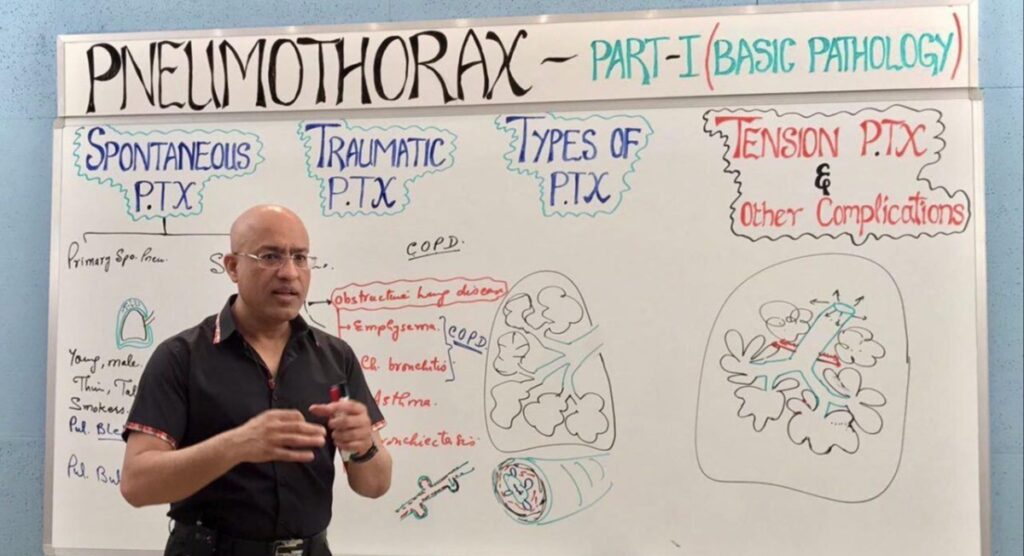
- Pneumothorax is explained through the mechanics of the pleural space.
- Cystic fibrosis is taught from the defective channel to the multisystem consequences.
- The Pancoast tumor is connected to the anatomy of the thoracic inlet.
- Handwritten notes for every lecture give you a clear revision set.
Key topics you will master
- Explain how a pneumothorax develops and its consequences
- Describe the pathology of cystic fibrosis
- Explain why a Pancoast tumor produces its characteristic signs
- Link the pathology of each disease to the underlying physiology and anatomy
Clinical pearls inside the lectures
- Spontaneous and tension pneumothorax
- Cystic fibrosis and its multisystem effects
- Pancoast tumor and Horner syndrome
- Lung carcinoma
The complete lecture list (7 parts)
| Module | Topics (number of lecture parts) | Parts |
|---|---|---|
| 1. Pneumothorax | Pneumothorax: Basic Pathology (2) | 2 |
| 2. Cystic fibrosis | Cystic Fibrosis (4) | 4 |
| 3. Lung carcinoma | Lung Carcinomas: Pancoast Tumor (1) | 1 |
Total: 7 lecture parts.
Perfect if you are
- Medical students revising respiratory disease
- Nursing and physiotherapy students who care for patients with lung disease
- Anyone who wants a short, focused review before an exam
- Candidates preparing for USMLE Step 1, PLAB, COMLEX or NEET PG
With seven lectures, the course fits easily into a short revision window.
A suggested study routine
- Watch the lectures in order and keep the pleural anatomy diagram beside you.
- Draw the cystic fibrosis pathway from the CFTR defect to its effects.
- Revisit the Pancoast tumor lecture after reviewing the brachial plexus.
- Review from the handwritten notes.
These courses connect naturally with Respiratory Pathology: Respiratory Physiology for lung mechanics and gas exchange, Clinical Pearls: Questions and Answers for six questions on Pancoast tumor, General Pathology for cancer and paraneoplastic syndromes, Clinical Medicine for cystic fibrosis and Horner syndrome and Upper Limb for the brachial plexus involved in Pancoast tumor.
Quick facts on respiratory pathology
What is a pneumothorax?
A pneumothorax is air in the pleural space, which causes the lung to collapse. It may be spontaneous, traumatic or iatrogenic.
What is a tension pneumothorax?
In a tension pneumothorax, air enters the pleural space through a one-way valve and cannot escape. Rising pressure shifts the mediastinum, compresses the other lung and reduces venous return, and it is a medical emergency.
What causes cystic fibrosis?
Cystic fibrosis is caused by mutations in the CFTR gene, which encodes a chloride channel. Defective chloride transport produces thick secretions that affect the lungs, pancreas and other organs.
Which organs are affected in cystic fibrosis?
The lungs, pancreas, liver, intestines and reproductive tract are all affected. Chronic lung infection is the main cause of morbidity and mortality.
What is a Pancoast tumor?
A Pancoast tumor is a lung cancer at the apex that invades the brachial plexus and the sympathetic chain, causing shoulder and arm pain and often Horner syndrome.
What are the main types of lung cancer?
Lung cancer is divided into small cell lung cancer and non-small cell lung cancer, which includes adenocarcinoma, squamous cell carcinoma and large cell carcinoma.
Answers before you enrol
Do I need prior knowledge before starting respiratory pathology?
No. Each lecture explains the basics first, so a beginner can follow them. If you already know the topics, they work as a quick revision.
How many lectures are in the respiratory pathology course?
The course contains 7 lecture parts organized into three modules.
Which topics does the respiratory pathology course cover?
It covers pneumothorax, cystic fibrosis and lung carcinomas with a focus on the Pancoast tumor.
Can I try some lectures before I buy?
Yes. Create a free Try Us Free account to watch sample lectures and see how Dr. Najeeb teaches before you choose a plan.
Do the lectures come with notes?
Yes. Handwritten notes are available for every lecture in this course. They are sold separately through the Notes add-on or the Combo Plan.
How long do I keep access to the lectures?
The premium plan gives you lifetime access, including any new lectures added to the library later.
Can I watch the lectures offline?
Offline viewing works only inside the official Dr. Najeeb Lectures app. The videos cannot be downloaded as separate files.
Will this course help with USMLE, PLAB, COMLEX or NEET PG?
It covers the respiratory pathology content that these exams test. It does not include a question bank or a certificate.
Can I get a refund?
Dr. Najeeb Lectures offers a 7-day refund. Email support@drnajeeblectures.com to request one.