
Respiratory Physiology
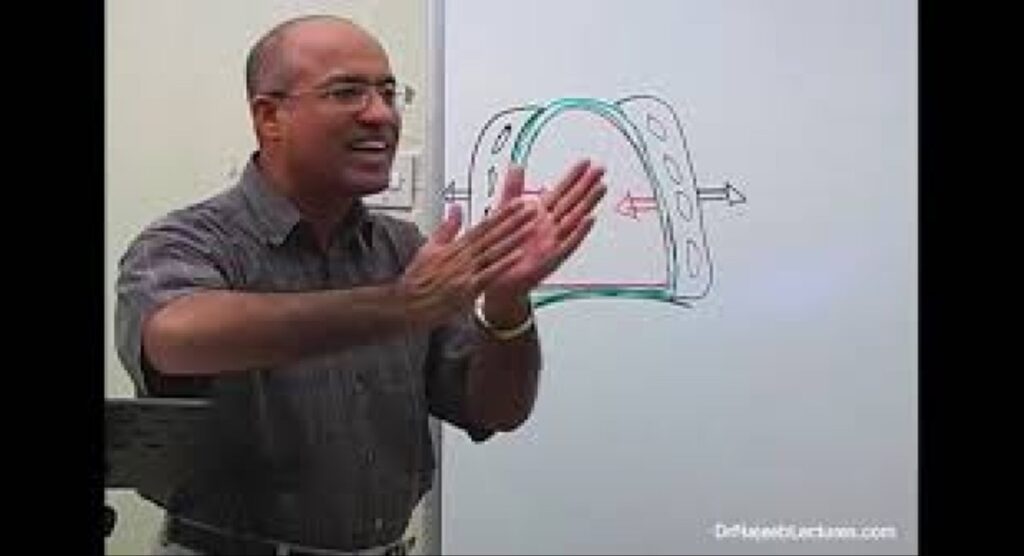
Breathing looks effortless until you ask how a thin sheet of lung tissue moves oxygen into blood against every obstacle. Dr. Najeeb’s Respiratory Physiology course answers that question in 25 hand-drawn lectures, from the mechanics of a single breath to what happens when you climb to altitude. Every graph, from the compliance curve to the oxygen-hemoglobin dissociation curve, is drawn step by step so you understand why it has its shape. The course is taught by a teacher with over 40 years of experience.
| At a glance | Respiratory Physiology |
|---|---|
| Instructor | Dr. Najeeb, over 40 years of teaching experience |
| Course length | 25 video lecture parts in 5 modules |
| Teaching style | Live whiteboard drawing, one idea at a time |
| Prior knowledge | No background needed; the lectures begin with the mechanics of breathing |
| Access | Lifetime access with the premium plan, future lectures included |
| Notes | Handwritten notes for every lecture, sold separately (Notes add-on or Combo Plan) |
| Free preview | Sample lectures through a free “Try Us Free” account |
| Ideal for | Medical, dental, nursing, physiotherapy and respiratory therapy students; USMLE Step 1, PLAB, COMLEX and NEET PG candidates |
Why students choose this respiratory physiology course
Respiratory physiology is full of curves and ratios that students memorize without understanding. These lectures reverse that by teaching the reasoning first.
- Compliance, surface tension and surfactant are drawn together, so lung mechanics makes sense as one system.
- Gas transport is explained through the dissociation curve and what shifts it.
- The ventilation-perfusion ratio is taught regionally, which makes dead space and shunt easy to separate.
- Pulmonary function tests are presented so you can tell obstructive from restrictive disease at a glance.
- Handwritten notes for every lecture give you a clean revision set.
What you will master
- Explain how the lungs and chest wall generate and oppose airflow
- Interpret lung volumes and capacities and the compliance curve
- Describe how surfactant stabilizes alveoli
- Explain the pulmonary circulation and its distinct features
- Describe oxygen and carbon dioxide transport in blood
- Use the ventilation-perfusion ratio to explain hypoxemia
- Describe how breathing is controlled and how it adapts to exercise and altitude
- Distinguish obstructive from restrictive patterns on pulmonary function tests
Clinical relevance at a glance
- Neonatal respiratory distress and surfactant deficiency
- Obstructive and restrictive lung disease
- Hypoxia and its types
- Acute and chronic adaptation to altitude
- Ventilation-perfusion mismatch in lung disease
- Pulmonary hypertension and pulmonary edema
Curriculum overview: 5 modules, 25 parts
| Module | Topics (number of lecture parts) | Parts |
|---|---|---|
| 1. Mechanics of breathing | Lung Mechanics (2); Lung Compliance (2); Surface Tension and Surfactant (1); Lung Volumes and Capacities (2) | 7 |
| 2. Pulmonary circulation and V/Q | Pulmonary Circulation (4); Ventilation-Perfusion Ratio (2) | 6 |
| 3. Gas transport | Oxygen Transport (3); Carbon Dioxide Transport (1) | 4 |
| 4. Control and adaptation | Regulation of Respiration (2); Hypoxia (2); Respiration in Exercise (1); Respiration at High Altitude (2) | 7 |
| 5. Pulmonary function testing | Assessing Pulmonary Function: Obstructive vs Restrictive (1) | 1 |
Total: 25 lecture parts.
Who should enrol
- Medical students meeting respiratory physiology for the first time
- Nursing, physiotherapy and respiratory therapy students who need a strong base
- Anyone revising lung mechanics and gas exchange before an exam
- Candidates preparing for USMLE Step 1, PLAB, COMLEX or NEET PG
If you have ever memorized a dissociation curve without knowing why it bends, begin with the gas transport lectures.
Making the most of each lecture
- Master lung mechanics first, since every later topic depends on it.
- Redraw the compliance curve and the oxygen-hemoglobin curve until you can explain every shift.
- Study ventilation-perfusion with a patient example in mind.
- Finish with pulmonary function testing, then review from the handwritten notes.
Study Respiratory Physiology alongside Respiratory Pathology for lung disease and its mechanisms, Cardiac Physiology for the right heart and pulmonary flow, Blood Physiology for hemoglobin and oxygen carriage, Vascular Physiology for circulation and pressure and Clinical Medicine for respiratory cases at the bedside.
Respiratory Physiology questions, answered fast
What are the normal lung volumes?
In a healthy young adult, tidal volume is about 500 mL and total lung capacity is about 6 liters. Residual volume cannot be exhaled and keeps the alveoli from collapsing.
What does surfactant do?
Surfactant, produced by type II pneumocytes, lowers alveolar surface tension and prevents collapse at the end of expiration. Its absence in premature infants causes neonatal respiratory distress syndrome.
How is oxygen carried in blood?
About 98 percent of oxygen is bound to hemoglobin, and each gram can carry about 1.34 mL. The oxygen-hemoglobin curve shifts right with increased carbon dioxide, acid, temperature and 2,3-BPG, which releases oxygen more readily to tissues.
How is carbon dioxide transported?
About 70 percent is carried as bicarbonate, 20 to 23 percent as carbaminohemoglobin and the remainder dissolved in plasma.
What is the ventilation-perfusion ratio?
It compares alveolar ventilation with pulmonary blood flow. The ideal ratio is about 0.8 overall, higher at the lung apex and lower at the base. A shunt has a ratio of zero and dead space has a ratio approaching infinity.
What controls breathing?
Respiratory centers in the medulla and pons set the rhythm. Central chemoreceptors respond to changes in hydrogen ion concentration, driven by carbon dioxide, and peripheral chemoreceptors in the carotid and aortic bodies respond to low oxygen, high carbon dioxide and acidity.
How do spirometry results separate obstructive from restrictive disease?
Obstructive disease reduces the FEV1 to FVC ratio, usually below 0.7. Restrictive disease reduces lung volumes while the FEV1 to FVC ratio stays normal or rises.
What happens to the body at high altitude?
Low oxygen triggers increased ventilation, which causes respiratory alkalosis. Over days, erythropoietin rises, red cell mass increases and 2,3-BPG levels rise.
Course FAQs
Do I need prior knowledge before starting respiratory physiology?
No. The course starts with the mechanics of breathing and builds one idea at a time, so a beginner can follow it. If you already know the basics, it works as a quick revision of gas transport and ventilation-perfusion.
How long is the respiratory physiology course?
The course contains 25 lecture parts organized into 5 modules.
Which topics does the respiratory physiology course cover?
It covers lung mechanics, compliance, surfactant, lung volumes, pulmonary circulation, oxygen and carbon dioxide transport, the ventilation-perfusion ratio, control of breathing, hypoxia, exercise, high altitude and pulmonary function tests.
Can I try some lectures before I buy?
Yes. A free Try Us Free account lets you watch sample lectures first, so you can judge the teaching style before you subscribe.
Do the lectures come with notes?
Yes. Handwritten notes are available for every lecture in this course. They are sold separately through the Notes add-on or the Combo Plan.
How long do I keep access to the lectures?
Access lasts for life on the premium plan, and it includes lectures that are added in the future.
Can I watch the lectures offline?
You can watch offline only through the official Dr. Najeeb Lectures app. Separate video files are not available for download.
Will this course help with USMLE, PLAB, COMLEX or NEET PG?
It covers the respiratory physiology content that these exams test. It does not include a question bank or a certificate.
Can I get a refund?
A 7-day refund is available. To request it, email support@drnajeeblectures.com.