Membrane Physiology
Every cell in your body works like a tiny battery, and almost every exam question in physiology goes back to that idea. Membrane Physiology is where Dr. Najeeb builds it from the ground up. In 25 hand-drawn video lectures he shows how the membrane controls what moves in and out, how an electrical charge appears across it, how a nerve fires, and how glucose gets into cells. The course is taught by a teacher with over 40 years of experience.
| Course snapshot | Membrane Physiology |
|---|---|
| Teacher | Dr. Najeeb, over 40 years of teaching experience |
| Length | 25 video lecture parts in five modules |
| Teaching style | Step-by-step whiteboard drawing |
| Prior knowledge | None required; starts from the cell membrane |
| Access | Lifetime access with the premium plan, future lectures included |
| Notes | Handwritten notes for every lecture, sold separately (Notes add-on or Combo Plan) |
| Free preview | Sample lectures through a free Try Us Free account |
| Ideal for | Medical, dental, nursing, pharmacy and physiotherapy students; USMLE Step 1, PLAB, COMLEX and NEET PG candidates |
Why membrane physiology feels hard, and how this course fixes that
Membrane potentials and ion channels confuse students because textbooks give the result without the reason. In these lectures the diagram grows in front of you, and every number is tied to a mechanism you can picture.
- Each concept is built from the one before it, so nothing feels like a jump.
- Ion movements are drawn out, which makes the logic easy to recall in an exam.
- Clinical examples show why the physiology matters at the bedside.
- Handwritten notes for every lecture give you a clean page to revise from.
Skills you will take away from these lectures
- Explain how the cell membrane is built and how substances cross it
- Tell passive transport, facilitated diffusion and active transport apart
- Work out why the resting membrane potential is negative
- Follow an action potential phase by phase
- Describe how a nerve signal crosses the neuromuscular junction
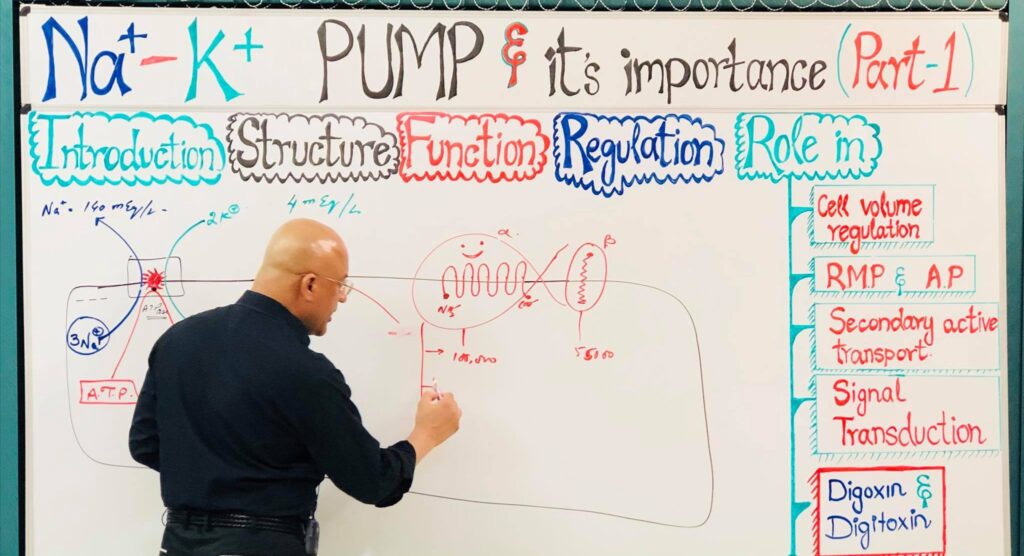
- Explain why the sodium-potassium pump matters
- Calculate and compare body fluid compartments
- Describe how GLUT transporters move glucose in different tissues
Where this shows up in clinical practice
- Nerve conduction and why it can fail
- Muscle weakness linked to neuromuscular transmission
- Ion imbalance and its effect on excitable tissues
- Fluid shifts between body compartments
- Glucose uptake and diabetes
- Why some drugs act on channels and pumps
Course roadmap: 25 lectures in five modules
| Module | Topics (number of lecture parts) | Parts |
|---|---|---|
| 1. Membrane basics | Cell Membrane (2); Membrane Transport Mechanisms (2) | 4 |
| 2. Electrical signals in cells | Resting Membrane Potential (3); Action Potential (3) | 6 |
| 3. Nerve-to-muscle signalling | Neuromuscular Junction and Transmission (2); Na+ K+ Pump and Its Importance (1) | 3 |
| 4. Body fluids | Body Fluid Compartments (4) | 4 |
| 5. Glucose transport | Glucose Transport Across the Membranes, GLUTs (8) | 8 |
Total: 25 lecture parts.
Who will get the most out of this course?
- First-year medical students meeting physiology for the first time
- Dental, nursing, pharmacy and physiotherapy students who need a strong base
- Students revising nerve and muscle physiology before an exam
- Candidates preparing for USMLE Step 1, PLAB, COMLEX or NEET PG
If membrane potentials have always felt confusing, starting from lecture one is the easiest way in.
How to study this course
- Watch one lecture at a time and redraw the diagram without looking.
- Say out loud which way each ion moves and why.
- Review the handwritten notes the same day.
- Finish the electrical signals module before the neuromuscular junction lectures, since the second builds on the first.
Pair this course with Histology to see membrane structure in real tissue, Neuro Anatomy & Neuro Physiology to see action potentials in the nervous system, and Blood Physiology for the next step in your physiology plan. Next, apply these principles in Cardiac Physiology and the ECG Series for the cardiac action potential, Renal Physiology for tubular transport, Endocrine Physiology and Diabetes Mellitus for GLUT transporters and the sodium-potassium pump, Nervous System Pathology for disorders of the neuromuscular junction and Pharmacology for drugs that act on channels and receptors.
Membrane physiology quick answers
What is the resting membrane potential?
It is the steady electrical difference across a resting cell membrane, with the inside negative compared with the outside. In most neurons it sits at about -70 mV, and it comes mainly from the way potassium leaks out through channels while the membrane is far less permeable to sodium.
What happens during an action potential?
A stimulus opens voltage-gated sodium channels, so sodium rushes in and the membrane depolarizes. Sodium channels then inactivate and voltage-gated potassium channels open, so potassium flows out and the membrane repolarizes, sometimes briefly overshooting into hyperpolarization.
What does the sodium-potassium pump do?
The Na+/K+ ATPase uses ATP to move three sodium ions out of the cell and two potassium ions in. This keeps the concentration gradients that the resting potential and nerve signalling depend on.
How does the neuromuscular junction pass a signal to muscle?
When a motor neuron fires, calcium entry triggers release of acetylcholine into the synaptic cleft. Acetylcholine binds receptors on the muscle fibre, opens channels and starts a muscle action potential. Acetylcholinesterase then breaks the transmitter down to end the signal.
What are the main body fluid compartments?
Total body water is divided into intracellular fluid, which is about two thirds, and extracellular fluid, which is about one third. The extracellular part is split into interstitial fluid and blood plasma.
What is the difference between simple diffusion, facilitated diffusion and active transport?
Simple diffusion moves molecules down their gradient directly through the membrane. Facilitated diffusion also moves them down their gradient but uses a carrier or channel. Active transport moves them against their gradient and needs energy, either directly from ATP or indirectly from another gradient.
How does glucose cross cell membranes?
Most cells take up glucose through facilitated diffusion using GLUT transporters. The kidney and intestine also use SGLT transporters, which couple glucose to sodium and move it against its gradient.
Common questions about this course
Do I need to know physiology before starting?
No. The course starts with the structure of the cell membrane and builds up one step at a time, so a complete beginner can follow it. If you already know the basics, it works well as a focused revision of the topics that exams love to test.
How many lectures are in the membrane physiology course?
The course contains 25 lecture parts, from the first cell membrane lecture to the eighth and final glucose transport lecture.
Which topics does the course cover?
It covers the cell membrane, membrane transport mechanisms, resting membrane potential, action potential, the neuromuscular junction, the sodium-potassium pump, body fluid compartments and glucose transport through the GLUT family.
Can I watch some lectures before I buy?
Yes. Create a free Try Us Free account to watch sample lectures and see how Dr. Najeeb teaches before you pick a plan.
Are handwritten notes available?
Yes. Handwritten notes are available for every lecture in this course. They are sold separately through the Notes add-on or the Combo Plan.
How long does my access last?
The premium plan gives lifetime access, including new lectures added to the library in the future.
Can I download the lectures to watch offline?
Offline viewing is possible only inside the official Dr. Najeeb Lectures app. The videos cannot be downloaded as separate files.
Is this course useful for USMLE, PLAB, COMLEX or NEET PG?
Yes, it covers the membrane and transport physiology those exams test. It does not include a question bank or a certificate.
What is the refund policy?
Dr. Najeeb Lectures offers a 7-day refund. Email support@drnajeeblectures.com to ask for one.