
Vascular Physiology
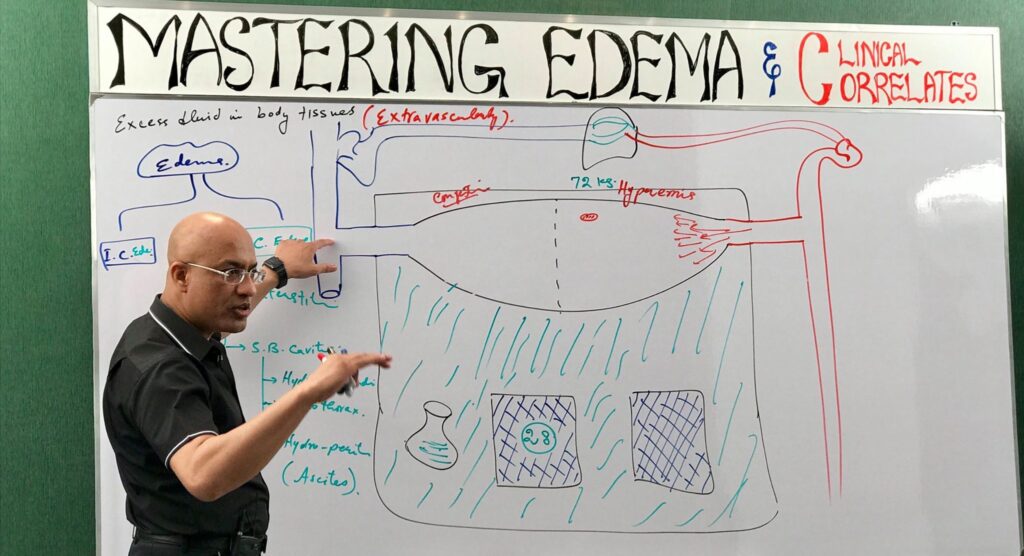
Blood pressure is not a single number but the result of flow, resistance and the vessels that carry it. Dr. Najeeb’s Vascular Physiology course shows how pressure, flow and resistance relate, how the body holds blood pressure steady from moment to moment, and why fluid sometimes leaves the capillaries and collects as edema. Across 20 hand-drawn lectures, each idea is built on the last. The course is taught by a teacher with over 40 years of experience.
| At a glance | Vascular Physiology |
|---|---|
| Teacher | Dr. Najeeb, over 40 years of teaching experience |
| Number of lectures | 20 video lecture parts in 4 modules |
| How it is taught | Live whiteboard drawing, one idea at a time |
| Where to begin | No background needed; the lectures begin with hemodynamics |
| Plan | Lifetime access with the premium plan, future lectures included |
| Handwritten notes | Handwritten notes for every lecture, sold separately (Notes add-on or Combo Plan) |
| Sample lectures | Sample lectures through a free “Try Us Free” account |
| Suited to | Medical, dental, nursing and physiotherapy students; USMLE Step 1, PLAB, COMLEX and NEET PG candidates |
Learn vascular physiology by understanding, not memorizing
Hemodynamics has a reputation for being mathematical. In these lectures the equations are drawn from simple pictures, so the logic is clear before any formula appears.
- Flow, pressure and resistance are explained with diagrams, so Poiseuille and Ohm’s law become intuitive.
- Blood pressure regulation is shown as a feedback loop, which makes reflexes and hormones easy to place.
- Edema is explained through Starling forces, so every cause can be reasoned out.
- Handwritten notes for every lecture give you a clear revision set.
By the end you will understand
- Relate flow, pressure and resistance in the circulation
- Explain how vessel radius changes resistance so dramatically
- Describe short-term and long-term regulation of blood pressure
- Explain how fluid moves across capillaries through Starling forces
- List the causes of edema and reason out each mechanism
- Describe the body fluid compartments and how they exchange water
- Explain the role of neutrophils in acute inflammation
Real-world and exam relevance
- Hypertension and hypotension
- Edema in heart failure, liver disease and nephrotic syndrome
- Shock and the compensatory responses
- Dehydration and fluid shifts
- Vascular resistance and drug action
- Inflammation and increased vascular permeability
Course map: 20 lecture parts, module by module
| Module | Topics (number of lecture parts) | Parts |
|---|---|---|
| 1. Hemodynamics | Hemodynamics (6) | 6 |
| 2. Blood pressure regulation | Blood Pressure Regulation (4) | 4 |
| 3. Microcirculation and edema | Microcirculation (2); Mastering Edema (3) | 5 |
| 4. Fluids and inflammation | Body Fluid Compartments (4); Neutrophils in Acute Inflammation (1) | 5 |
Total: 20 lecture parts.
Built for these learners
- Students who find hemodynamics intimidating
- Dental, nursing and physiotherapy students who need a clear cardiovascular base
- Anyone revising blood pressure and edema before an exam
- Candidates preparing for USMLE Step 1, PLAB, COMLEX or NEET PG
If equations have put you off this topic, the hemodynamics lectures are built to change that.
Study tips built into the course design
- Work through hemodynamics before blood pressure regulation, since the second depends on the first.
- Redraw the Starling forces diagram until you can place every cause of edema on it.
- Link each regulatory reflex to the sensor, the effector and the result.
- Review each module from the handwritten notes the same day.
To see the bigger picture, continue with Cardiac Physiology for cardiac output and the heart as a pump, Renal Physiology for long-term blood pressure control, Vascular Pathology for hypertension and atherosclerosis, Blood Physiology for the cells and clotting factors in the circulation and General Pathology for edema, shock and inflammation.
Vascular Physiology in brief
What is the relationship between pressure, flow and resistance?
Flow equals the pressure difference divided by resistance. Because resistance varies with the fourth power of the vessel radius, a small change in arteriolar radius has a large effect on flow and pressure.
How is mean arterial pressure calculated?
Mean arterial pressure is approximately the diastolic pressure plus one third of the pulse pressure. It also equals cardiac output multiplied by total peripheral resistance.
How does the baroreceptor reflex work?
Stretch receptors in the carotid sinus and aortic arch sense arterial pressure. A fall in pressure reduces their firing, which increases sympathetic activity and reduces vagal tone, raising heart rate and vascular resistance.
What are Starling forces?
Capillary hydrostatic pressure and interstitial oncotic pressure push fluid out of the capillary, while capillary oncotic pressure and interstitial hydrostatic pressure pull fluid back in. The balance determines net fluid movement.
What causes edema?
Edema results from increased capillary hydrostatic pressure, decreased plasma oncotic pressure, increased capillary permeability or lymphatic obstruction.
How are the body fluid compartments divided?
Total body water divides into intracellular fluid, about two thirds, and extracellular fluid, about one third. Extracellular fluid is split into interstitial fluid and plasma.
Your questions, answered
Do I need prior knowledge before starting vascular physiology?
No. The course begins with the basics of flow and pressure, so a beginner can follow it. If you already know the foundations, it works as a focused revision of blood pressure and edema.
How many vascular physiology lectures can I watch?
The course contains 20 lecture parts organized into 4 modules.
Which topics does the vascular physiology course cover?
It covers hemodynamics, blood pressure regulation, microcirculation, edema, body fluid compartments and the role of neutrophils in acute inflammation.
Can I try some lectures before I buy?
Yes. Sign up for a free Try Us Free account, watch the sample lectures, then decide whether to upgrade.
Do the lectures come with notes?
Yes. Handwritten notes are available for every lecture in this course. They are sold separately through the Notes add-on or the Combo Plan.
How long do I keep access to the lectures?
With the premium plan you keep access permanently, and new lectures are included at no extra cost.
Can I watch the lectures offline?
Offline access is limited to the official Dr. Najeeb Lectures app, and the videos cannot be saved as standalone files.
Will this course help with USMLE, PLAB, COMLEX or NEET PG?
It covers the vascular physiology content that these exams test. It does not include a question bank or a certificate.
Can I get a refund?
Refunds are available within 7 days. Email support@drnajeeblectures.com and the team will help.