
Bone & Joints Pathology
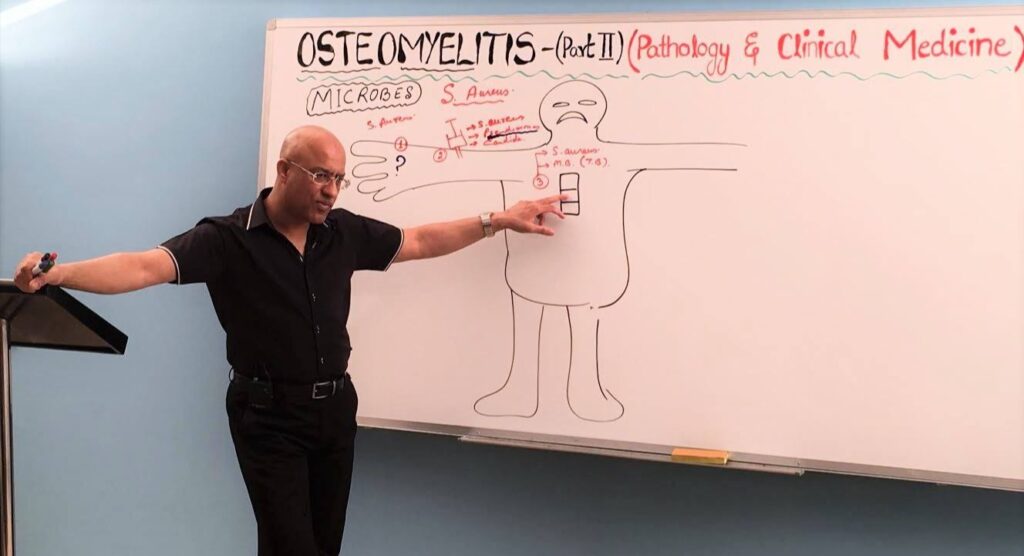
Bone looks inert on an X-ray, but when infection reaches it, the consequences are serious: pain, fever, dead bone and, if untreated, chronic disease that can last for years. This focused course gives osteomyelitis the time it deserves. In three hand-drawn lectures, Dr. Najeeb explains how bacteria reach bone, what they do when they get there and why the clinical picture looks the way it does. The course is taught by a teacher with over 40 years of experience.
| At a glance | Bone & Joints Pathology |
|---|---|
| Instructor | Dr. Najeeb, over 40 years of teaching experience |
| Course length | 3 video lecture parts on osteomyelitis |
| Teaching style | Live whiteboard drawing, one idea at a time |
| Prior knowledge | No background needed; the lectures begin with the basics of bone infection |
| Access | Lifetime access with the premium plan, future lectures included |
| Notes | Handwritten notes for every lecture, sold separately (Notes add-on or Combo Plan) |
| Free preview | Sample lectures through a free “Try Us Free” account |
| Ideal for | Medical, dental, nursing and physiotherapy students; USMLE Step 1, PLAB, COMLEX and NEET PG candidates |
Why students choose this bone and joint pathology course
A short course on a single high-yield topic is the fastest way to secure it. Osteomyelitis is a frequent exam subject and an important clinical one.
- The route of infection is explained clearly, so the typical organism and site make sense.
- Pathology is drawn step by step, so terms such as sequestrum and involucrum have a visual meaning.
- Three lectures make this an ideal course for quick revision.
- Handwritten notes for every lecture give you a clear study set.
What you will master
- Explain how bone becomes infected
- Describe the pathological changes of acute and chronic osteomyelitis
- Explain terms such as sequestrum and involucrum
- Link the clinical features to the underlying pathology
Clinical relevance at a glance
- Acute hematogenous osteomyelitis
- Chronic osteomyelitis
- Osteomyelitis in sickle cell disease
- Post-traumatic and contiguous bone infection
- Bone abscess
Course outline: 3 lecture parts on osteomyelitis
| Module | Topics (number of lecture parts) | Parts |
|---|---|---|
| 1. Osteomyelitis | Osteomyelitis (3) | 3 |
Total: 3 lecture parts.
Who should enrol
- Medical students revising bone infections
- Physiotherapy and nursing students who care for patients with bone disease
- Anyone who wants a short, focused review before an exam
- Candidates preparing for USMLE Step 1, PLAB, COMLEX or NEET PG
The three lectures can be completed in a single study session.
Making the most of each lecture
- Watch the three lectures in order.
- Draw the pathology of acute osteomyelitis from memory.
- Link the typical organism to the patient group.
- Review from the handwritten notes.
To see the bigger picture, continue with General Pathology for inflammation and necrosis, Clinical Medicine for osteomyelitis cases and other bedside topics, Microbiology for the organisms that infect bone, Immunology for how the body responds to infection and Hematopoietic and Lymphoid Pathology for sickle cell and other blood disorders.
Bone & Joints Pathology questions, answered fast
What is osteomyelitis?
Osteomyelitis is an infection of bone and bone marrow, most often caused by bacteria. It may be acute or chronic.
Which organism most often causes osteomyelitis?
Staphylococcus aureus is the most common cause. Salmonella species are a classic cause in patients with sickle cell disease.
How does bone become infected?
Infection may spread through the blood (hematogenous), extend from a nearby site such as an infected ulcer, or enter directly after trauma or surgery.
What are a sequestrum and an involucrum?
A sequestrum is a fragment of dead bone surrounded by infected tissue. An involucrum is a sheath of new bone that forms around it.
Where does acute hematogenous osteomyelitis usually occur in children?
It most often affects the metaphysis of long bones, where the blood flow is slow and bacteria can settle.
How is osteomyelitis diagnosed?
Diagnosis combines clinical findings, inflammatory markers, blood cultures or bone biopsy, and imaging. MRI detects early disease, while plain X-ray changes appear after about 10 to 14 days.
Course FAQs
Do I need prior knowledge before starting bone and joint pathology?
No. The lectures start with the basics of bone infection, so a beginner can follow them. If you already know the topic, they work as a quick revision.
How long is the bone and joint pathology course?
The course contains 3 lecture parts, all on osteomyelitis.
Which topics does the bone and joint pathology course cover?
It covers osteomyelitis, including how bone becomes infected, the pathology of acute and chronic disease and the associated clinical features.
Can I try some lectures before I buy?
Yes. A free Try Us Free account lets you watch sample lectures first, so you can judge the teaching style before you subscribe.
Do the lectures come with notes?
Yes. Handwritten notes are available for every lecture in this course. They are sold separately through the Notes add-on or the Combo Plan.
How long do I keep access to the lectures?
Access lasts for life on the premium plan, and it includes lectures that are added in the future.
Can I watch the lectures offline?
You can watch offline only through the official Dr. Najeeb Lectures app. Separate video files are not available for download.
Will this course help with USMLE, PLAB, COMLEX or NEET PG?
It covers the bone and joint pathology content that these exams test. It does not include a question bank or a certificate.
Can I get a refund?
A 7-day refund is available. To request it, email support@drnajeeblectures.com.